Disclosure: As an Amazon Associate, DishStories may earn from qualifying purchases at no extra cost to you.
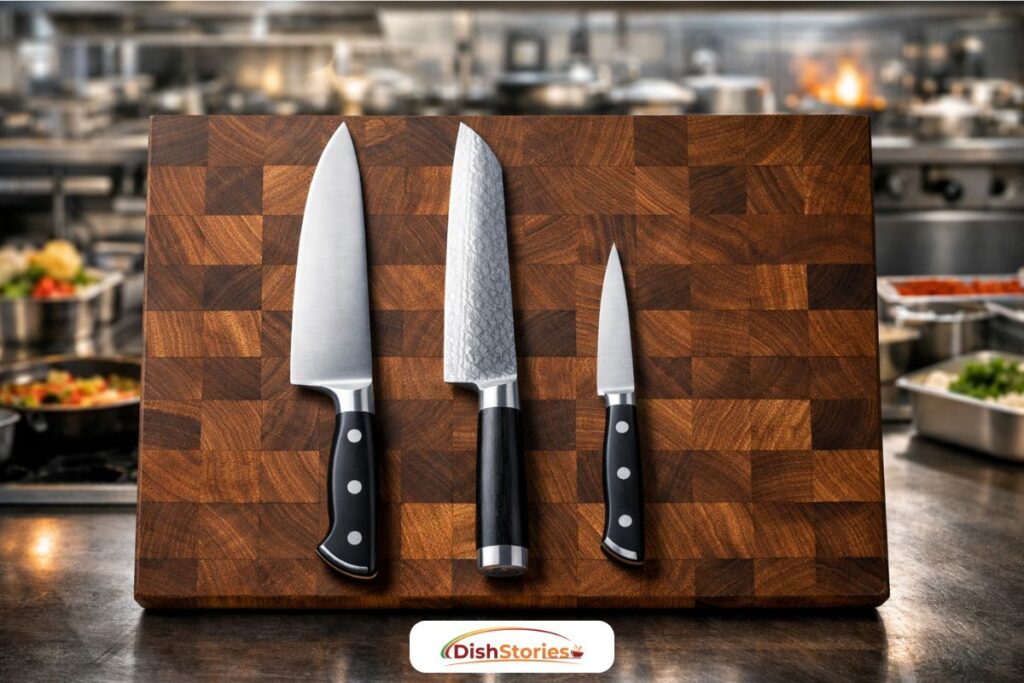
Introduction: The Secret of the 5-Star Kitchen
Walk into any home goods store and you’ll see rows of gleaming 20-piece knife blocks promising to turn you into a master chef. Here’s the truth from someone who has managed the accounts and operations of 5-star hotel kitchens: no professional chef ever relied on that many blades.
I remember one specific banquet service where our team had to prep over 200 portions of pan-seared salmon and complex seasonal root vegetable garnishes within a three-hour window. We didn’t reach for a massive kit of gadgets; we did the entire job with just three high-quality knives.
Professional culinary knives aren’t about quantity; they’re about quality. The best rated knives by chefs are tools that feel like weightless extensions of the hand, capable of handling hours of intense, repetitive prep without causing palm blisters or wrist fatigue. In this guide, I’ll break down what makes a knife truly professional, the technical science behind the steel, and the essential blades every serious cook should own to build their own Kitchen Essentials collection.
1. The Heritage of the Blade: A Brief History of Chef Knives
To understand why we pay $200 for a knife today, we have to look back at the centuries of engineering that led us here.
- The European Tradition (Solingen, Germany): The city of Solingen has been a center for blacksmithing for over 2,000 years. Originally, these blacksmiths forged swords for the knights of Europe. As warfare changed, they transitioned their skill into high-carbon steel kitchen cutlery. This is why German knives are known as “tanks”—they are built with the same durability as a medieval broadsword.
- The Japanese Legacy (Seki, Japan): Similarly, the Japanese knife industry grew out of the Samurai tradition. When the carrying of swords was banned in the late 19th century, master sword-smiths turned to kitchen tools. They applied the “Wazashu” (the art of sharpening) to culinary blades, creating the ultra-thin, razor-sharp edges we see in brands like Shun and Global today.
2. The 2026 Landscape: What’s New in Professional Cutlery?
The world of professional kitchen knives has evolved rapidly over the last two years. While the classics remain, three major shifts have changed what we look for when stocking a 5-star kitchen today:
- The Rise of Powder Metallurgy (SG2 and R2 Steels): In 2026, we are seeing more chefs move toward “Super Steels.” These are created using powder metallurgy, allowing for a knife that is even harder than traditional Japanese steel but less prone to chipping. It’s the perfect middle ground for a busy professional environment.
- Eco-Conscious Handle Materials: Sustainability has moved from the menu to the tool kit. High-performance recycled composites (like G10 or stabilized wood) are replacing rare hardwoods. These materials are non-porous and more hygienic, making them favorites for health inspectors in 2026.
- The “Hybrid” Blade Shape: We are seeing a massive trend in “Kiritsuke” shapes—a hybrid between a Chef’s knife and a vegetable cleaver. Its sword-like tip is becoming the “must-have” for chefs who want one tool that can handle both delicate fish butchery and heavy vegetable prep.
3. Anatomy of a Professional Culinary Knife
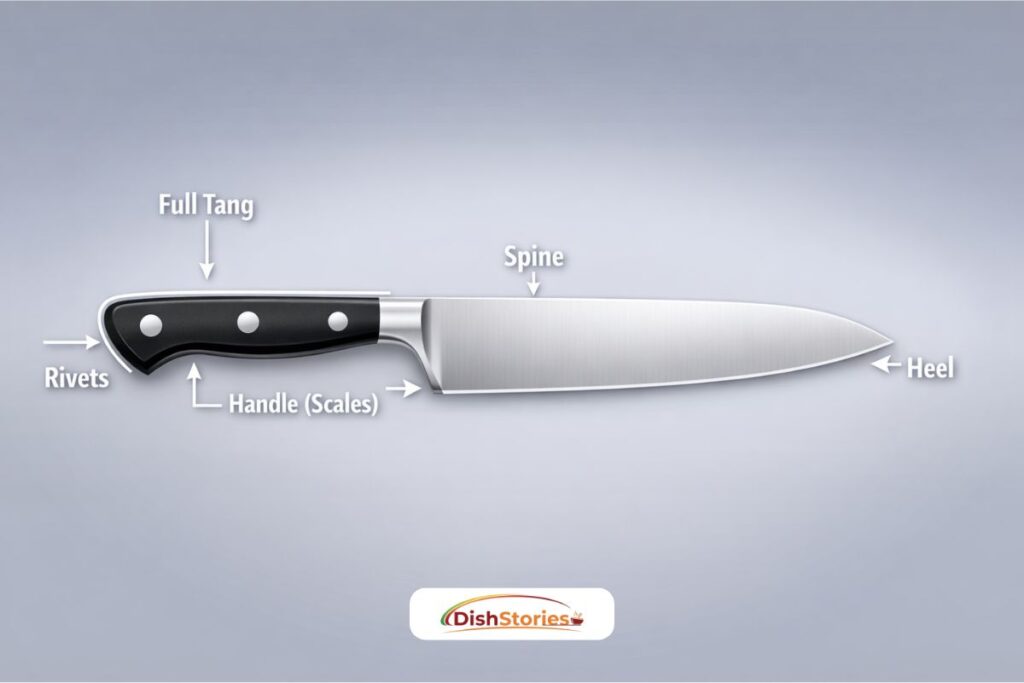
Understanding knife anatomy is the first step in identifying a “lifetime” tool. While a cheap supermarket knife is laser-cut from a thin sheet of metal, a professional forged knife has a complex, intentional architecture.
Why Full Tang is Non-Negotiable
The “tang” is the part of the steel that extends into the handle. A full tang means the steel runs the entire length and width of the handle, usually secured by three rivets. This is vital for balance; a “partial tang” knife is front-heavy and will cause significant wrist strain. In our hotel kitchens, we rejected any knife that wasn’t full tang because the handle could literally snap under the pressure of heavy-duty butchery.
The Role of the Bolster
The bolster is the thick collar of steel between the handle and the blade. It serves two purposes: it acts as a finger guard for safety and provides the “heft” needed to power through tougher ingredients like butternut squash or large cuts of meat. A well-designed bolster allows for a “pinch grip,” where you hold the blade itself for surgical control.
The Spine and the Heel
A thick spine indicates a strong blade that won’t flex when you apply downward pressure. The heel—the widest part of the edge nearest the handle—is designed for heavy-duty tasks that require the most leverage. In the hotel, we used the heel for everything from dicing hard carrots to cracking small bones when making veal stocks.
4. Forged vs. Stamped Knives: The Professional Standard
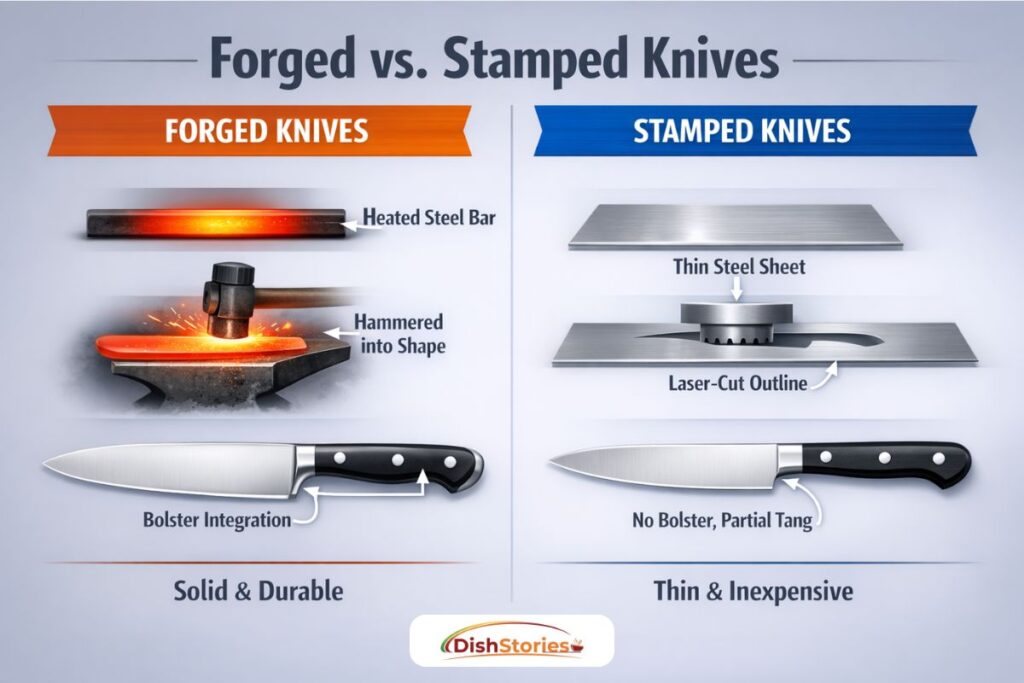
| Feature | Forged Knives | Stamped Knives |
| Manufacturing | Hammered from a single bar of red-hot steel | Laser-cut from a flat sheet of steel |
| Durability | High; resistant to bending and breaking | Lower; prone to snapping under pressure |
| Edge Retention | Superior; stays sharp for weeks | Requires frequent sharpening |
| Weight | Heavier; uses its own weight to cut | Lighter; requires more hand pressure |
Chef’s Verdict: In my experience, forged knives were the non-negotiable standard. Their weight does the mechanical work for you, making a four-hour prep session much less exhausting for your hands.
5. The “Holy Trinity” and Specialty Blades
You don’t need a block; you need these three must-have kitchen knives, followed by a few specialized tools if you are a serious home cook.
The Chef’s Knife (8–10 inches)
This is your primary workhorse. Whether you choose a curved Western-style blade for “rocking” cuts or a flatter Japanese-style blade for “push-pull” slicing, this knife handles 90% of your work. Even for a best chef knife for beginners, look for “knuckle clearance”—the distance between the handle and the board—so you don’t hit your hand while chopping.
Precision dicing is key for recipes like our Chai-Spiced Apple Crumble, where uniform apple chunks ensure even baking.
The Paring Knife (3–4 inches)
Think of this as the “scalpel.” It’s used for off-the-board tasks like peeling an apple in your hand or de-veining shrimp. I used mine daily for intricate garnishes during banquet plating—those tiny radish roses require a small, agile blade.
The Serrated Knife (Bread Knife)
Its saw-like teeth are essential for anything with a hard crust and a soft interior. In my hotel days, the pastry chefs swore by these for slicing delicate opera cakes without crushing the precise layers of ganache and sponge.
Beyond the Trinity: Specialty Blades
- The Boning Knife: A flexible, thin blade used for removing meat from bone. If you buy whole chickens to save money, a boning knife is essential.
- The Cleaver: Not for precision, but for power. If you are hacking through spare ribs or heavy squash, the weight of the cleaver protects your delicate Chef’s knife from chipping.
- The Santoku: The Japanese version of a Chef’s knife. It usually has “grantons” (dimples) on the side to prevent starchy foods like potatoes from sticking to the blade.
6. Japanese vs. German Steel: The Great Debate
The most popular chefs knife brands usually fall into these two categories based on their steel hardness, measured by the Rockwell Scale.
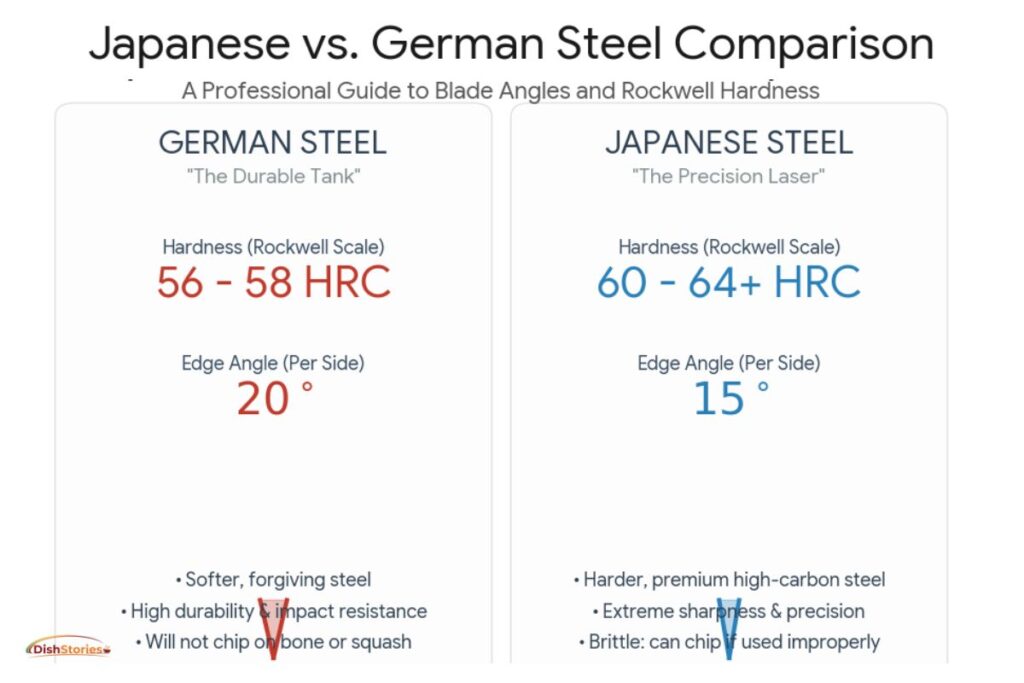
- German Steel (The Tank): Usually around 56 HRC on the Rockwell Scale. This steel is “softer” and incredibly durable. Brands like Wüsthof or Zwilling use a $20^\circ$ angle. It won’t chip if you hit a bone.
- Japanese Steel (The Laser): Harder steel (60+ HRC) ground to a sharper $15^\circ$ angle. Brands like Shun or Global are precision instruments but are brittle; one wrong move on a frozen piece of meat can chip the edge.
7. The Science of Steel: Carbon vs. Stainless
In my hotel accounting days, I had to justify the high cost of replacement blades, which led me to study the metallurgy of what we were buying.
High-Carbon Steel: The Chef’s Choice
Carbon steel can be sharpened to a “surgical” level. It holds an edge longer than almost any other material. However, it is reactive. If you cut an onion or a lemon and don’t wipe the blade immediately, it will discolor (patina) or rust.
Stainless Steel: The Low-Maintenance Alternative
Chromium is added to prevent rust. These are great for busy home kitchens. However, they are generally “gummy” compared to carbon, making it harder to get that “scary sharp” edge.
8. The Ultimate Buying Guide: Investing in Excellence
Price Ranges: What to Expect
- Entry Level ($50–$90): Decent stamped knives (like Victorinox), but they lack the lifetime durability of forged steel.
- Professional Mid-Range ($100–$220): The “sweet spot.” Expect to spend around $150 for a forged chef’s knife that will last decades.
- Artisanal/Premium ($300+): Often hand-forged Japanese blades (Honyaki) or Damascus steel.
Trusted Brands to Consider
- Wüsthof & Zwilling: The German kings of durability.
- Shun & Global: Leading Japanese brands.
- MAC: A favorite among professional line cooks for its thin, razor-sharp profile.
The Store Test: The Balance Check
Before you buy, perform the “Chef’s Balance Test.” Balance the knife on your finger at the bolster—the point where the blade meets the handle. A perfectly balanced knife will stay level. If it tips sharply toward the blade, it will be “nose-heavy” and tire your arm out.
Our Top Heavy-Duty Pick: Wüsthof Classic 8-Inch Chef’s Knife
- Best For: Everyday heavy tasks, chopping bones, and longevity.
- Why Chefs Love It: It’s a “tank.” As mentioned in our German vs. Japanese section, this forged blade stays sharp through the toughest kitchen shifts.
Our Top Precision Pick: Shun Classic Blonde 8” Chef’s Knife
- Best For: Ultra-thin slicing, vegetables, and delicate protein work.
- Why Chefs Love It: This is the pinnacle of Japanese craftsmanship. Its 16-degree edge angle provides the “surgical” precision we discussed in the Steel Chemistry section.
9. Knife Skills: How to Handle a Knife Like a Pro
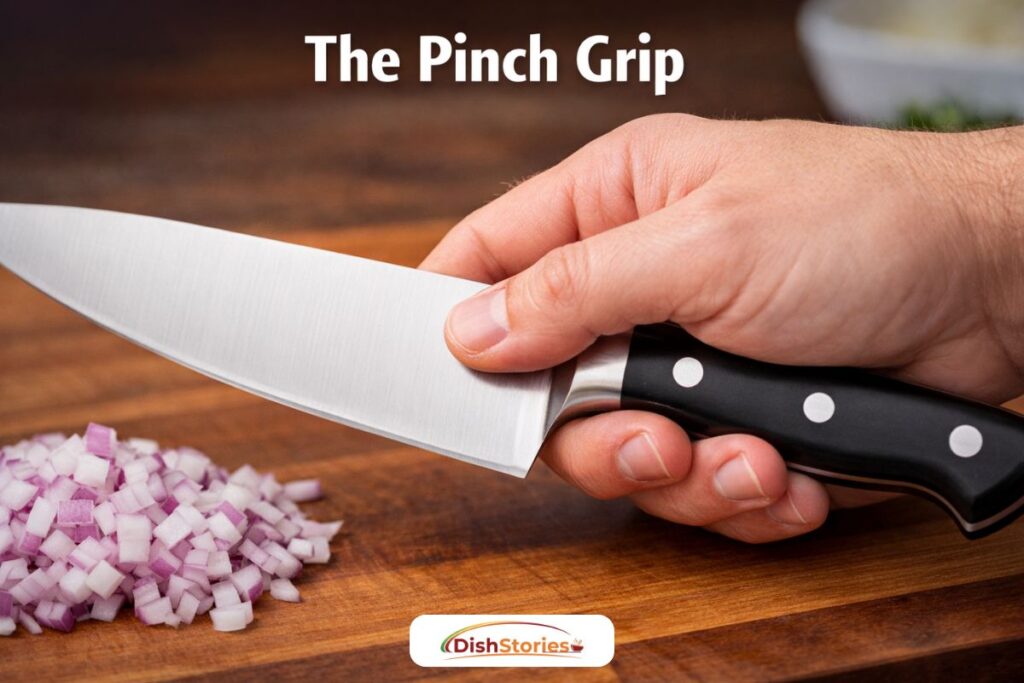
The Pinch Grip
Most home cooks hold the handle with all four fingers. Professionals “pinch” the blade itself between the thumb and the side of the index finger. This moves the center of gravity forward, giving you surgical control over the tip of the blade.
The Claw Technique
Your non-cutting hand should resemble a claw, with fingertips tucked in and knuckles acting as a guide for the blade. This is the single most important safety rule in a professional kitchen.
For a visual demonstration of these professional techniques, the Culinary Institute of America (CIA) offers excellent resources on foundational knife safety.
Rocking vs. Push-Pull Slicing
Once you have mastered the pinch grip, you must choose the stroke that matches the geometry of your blade. Using the wrong motion can either dull your knife prematurely or result in uneven, jagged cuts.
- The Rocking Motion (Western/German Style): German knives, like those from Wüsthof, have a significant “belly”—a curve that runs from the middle of the blade to the tip. This is designed for the rocking chop.
- How to do it: Keep the tip of the knife in constant contact with the cutting board. Lift the heel and the handle, then push down and forward in a circular, rocking motion.
- Best for: Rapidly dicing onions, mincing garlic, or finely chopping leafy herbs like parsley and cilantro.
- The Push-Pull Motion (Japanese Style): Japanese blades, such as a Santoku or Kiritsuke, are much flatter. If you try to “rock” a flat blade, the tip can dig into the board and snap. Instead, these require a horizontal sliding motion.
- How to do it: Start with the heel of the knife near the ingredient. Push the blade forward and down simultaneously, or pull it back toward you. The entire edge should make contact with the board at roughly the same time.
- Best for: Clean, surgical slices of fish (Sashimi), precision julienne of vegetables, or cutting through delicate proteins without tearing the fibers.
Chef’s Pro-Tip: In the high-volume kitchens I managed, we taught apprentices to listen to the sound. A rhythmic “click-click-click” of the rocking motion is great for prep speed, but a silent, smooth glide is the hallmark of a master using a high-carbon Japanese blade.
10. Professional Maintenance: How to Honor Your Blade
A dull knife is the most dangerous object in a kitchen.
- Honing vs. Sharpening: Honing realigns the edge (do this daily). Sharpening actually grinds away steel to create a new edge (every 3–6 months).
- Hand-Washing Only: Never put a professional knife in the dishwasher. The heat expands the handle and the detergent ruins the steel.
- Proper Storage: Use a magnetic strip. Airflow prevents bacteria growth and protects the edge.
11. 5 Common Mistakes That Are Killing Your Knives
- Scraping the Board with the Blade: This rolls the edge instantly. Always flip the knife and use the spine to scrape.
- The “Drawer of Death”: Tossing a knife into a utility drawer causes the edge to bang against other metal. Use a Blade Guard.
- Cutting on Glass or Marble: These surfaces are harder than steel. The surface won’t break—the knife edge will. Use wood.
- Leaving it in the Sink: Reaching into soapy water and grabbing a hidden blade is the leading cause of kitchen stitches.
- The Dishwasher: High-heat and caustic detergent warp handles and pit the steel.
Best Rated Knives by Chefs FAQ: Professional Secrets to Knife Mastery
What is the “Rockwell Hardness Scale,” and why should a home cook care?
The Technical Answer: The Rockwell Scale (specifically the HRC) measures the resistance of steel to indentation. Most German knives sit at 56-58 HRC, while Japanese blades reach 60-64 HRC.
The Chef’s Insight: Harder steel stays sharp longer but is “brittle”—it can chip like glass if it hits a bone. Softer steel (German) is “tough”—it might roll its edge, but you can easily steel it back into shape. For beginners, a 56-58 HRC is the safest bet.
Can I really use a Chef’s knife for everything?
The Practical Answer: Almost. In a professional kitchen, we call it the “workhorse” because it can handle 90% of tasks.
The Exception: Never use your Chef’s knife for prying open jars, cutting through frozen foods, or hacking through thick bones. This is how “chips” happen. For those tasks, keep a cheap, heavy cleaver or a dedicated “beater” knife in your drawer.
Why do professional chefs prefer a “Pinch Grip” over holding the handle?
The Technique: Instead of wrapping all fingers around the handle, place your thumb and the side of your index finger directly on the blade just past the bolster.
The Benefit: This moves the center of gravity into your hand. It gives you 100% control over the tip of the blade, stops the knife from “wobbling” during heavy cuts, and significantly reduces wrist fatigue.
How often should I actually sharpen my knives?
The Professional Schedule: You should hone (realign) your knife every single time you use it. You should sharpen (remove metal) every 6 to 12 months depending on use.
The Test: If your knife can’t slice through a ripe tomato skin without you having to “saw” it, it’s time for a professional sharpening or a session with a 1000-grit whetstone.
Are expensive “Damascus Steel” knives actually better?
The Truth: Modern Damascus (the wavy patterns on the blade) is mostly aesthetic. It is made by layering different steels together. While beautiful, a $300 Damascus knife won’t necessarily cut better than a $150 plain high-carbon steel knife.
The Recommendation: Buy Damascus if you love the art, but if you are on a budget, prioritize the “core steel” and the heat treatment over the pattern.
Is a wooden cutting board better for my knives than plastic?
The Science: Yes. End-grain wood boards allow the knife edge to slide between the wood fibers. Hard plastic or glass boards are “unforgiving” and will dull your edge much faster.
Chef’s Tip: Never use glass, marble, or ceramic cutting boards—they are the fastest way to ruin a $200 knife in a single afternoon.
How do I safely store my knives if I don’t want a bulky block?
The Professional Way: Use a magnetic wall strip. It keeps the blades dry, visible, and away from other metal tools that might nick the edge.
The Alternative: If you must use a drawer, buy “blade guards” (plastic sleeves). Never toss a naked blade into a utensil drawer; it’s dangerous for your fingers and deadly for the knife’s edge.
Conclusion
Building a professional-grade kitchen starts with a focused budget, not a crowded counter. Mastering knife skills isn’t just about speed; it’s about confidence.
Start with one forged chef’s knife. Master the pinch grip. Once you do, every meal becomes faster, safer, and more enjoyable. As we used to say in the hotel, “Your knife is your signature.” Make sure yours is sharp.