The Hook: The 5-Second Slurp Test
There was a time when the true measure of an Oreo milkshake recipe wasn’t just its sweetness or size, but its resistance. In a vinyl booth under the low hum of fluorescent lights, a glass would arrive—tall, frosted, and sweating slightly despite the cold. Inside: a deep, pale swirl punctuated by darker streaks. The straw—always slightly too narrow—stood upright like a challenge. You’d lean in, wrap your lips around it, and pull.
Nothing.
For a brief, glorious five seconds, the shake refused. It held its structure with quiet defiance, a velvet emulsion resisting collapse. Then, slowly, the seal would break. A dense ribbon would rise—cool, rich, punctuated by cocoa-dark crunch—and flood your palate in a way that felt engineered rather than accidental.
That was the standard.
Contrast that with the modern fast-food shake: aerated to the brink of foam, thin enough to sip immediately, collapsing under its own lack of structure. It’s not indulgence—it’s convenience.
A true Oreo thick shake belongs to a different lineage. It is not just blended; it is constructed. A deliberate balance of density, temperature, fat, and particulate texture. It is the intersection of physics and nostalgia, engineered to pass what we might call the 5-second slurp test.
And like any engineered system, perfection lies in understanding its architecture.
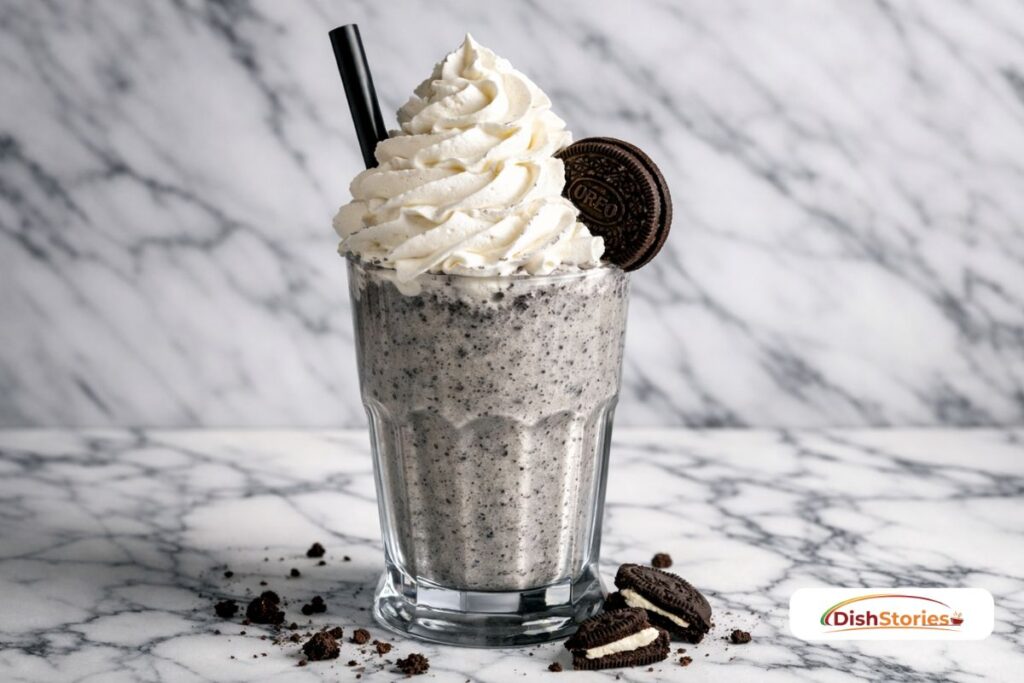
The Physics of Milkshake Architecture
A milkshake is deceptively simple: ice cream, milk, flavoring. But the difference between a watery disappointment and a structurally sound Oreo thick shake lies in a series of scientific principles that govern texture, stability, and flavor delivery.
Overrun & Ice Cream Density
The first—and most overlooked—variable is overrun.
Overrun refers to the amount of air incorporated into ice cream during churning. Commercial, low-cost ice creams often contain up to 100% overrun—meaning the volume is half air. This creates a product that is light, fluffy, and easy to scoop—but structurally weak.
When blended into a shake, this excess air collapses rapidly. The result? A thin, foamy liquid that fails the slurp test almost instantly.
In contrast, super-premium ice cream has low overrun (typically 20–30%) and higher fat content. This creates:
- Greater density, which resists dilution
- Improved mouthfeel, due to fat content
- Enhanced stability, as fewer air pockets collapse during blending
For a proper homemade Oreo milkshake, this is non-negotiable. The ice cream is not just an ingredient—it is the structural backbone.
The Emulsification Principle
At its core, a milkshake is an emulsion—a mixture of fat and water phases that would naturally separate if left unstructured.
Milk contributes water and proteins. Ice cream contributes fat (from cream) and emulsifiers (often lecithin from egg yolks in premium varieties). When blended correctly, these elements form a stable matrix where:
- Fat globules trap air
- Proteins stabilize the interface
- Sugars increase viscosity
This is what creates that signature “velvet” texture.
But emulsions are fragile. Over-blending introduces heat through friction, which destabilizes the fat structure. Under-blending fails to integrate components fully. The result in both cases is separation—either immediate or delayed.
A perfect cookies and cream milkshake with ice cream is therefore not just blended—it is controlled.
Milk Fat Percentages: The 2% vs. Whole Milk Debate
Milk Fat Percentages: The 2% vs. Whole Milk Debate
Milk is not a neutral liquid—it is a structural variable.
Lower-fat options like skim or 2% milk introduce a critical imbalance: too much water, not enough fat. During blending, this excess water is prone to forming micro ice crystals, especially under high shear conditions. These crystals disrupt the emulsion, thinning the shake and creating a slightly icy, fractured mouthfeel.
Whole milk, at approximately 3.25% fat, represents the functional baseline. It provides:
- Sufficient fat to support emulsification
- Improved viscosity
- Better integration with the ice cream’s fat matrix
Without this threshold, the shake becomes unstable almost immediately. For those pursuing a more indulgent architecture, a small addition of heavy cream (around 36% fat) transforms the system entirely.
The increased fat content enhances:
- Foam stability
- Air retention
- Mouth-coating richness
This creates what can only be described as an ultra-luxury thick shake—denser, slower to melt, and more resistant to separation. The key is restraint. Too much cream overwhelms the balance; just enough elevates it into something structurally superior.
Temperature Shock: The Silent Saboteur
Temperature is the most underestimated variable in milkshake construction.
When warm equipment meets cold ingredients, you introduce thermal imbalance. The ice cream melts unevenly, causing:
- Rapid thinning
- Loss of air structure
- Premature separation
This is known as temperature shock, and it is the reason many homemade shakes turn into soup within minutes.
The solution is simple but often ignored: pre-chill everything.
- Blender jar: at least 10 minutes in the freezer
- Serving glass: chilled until frosted
- Milk: as cold as possible without freezing
This ensures that the emulsion forms under stable thermal conditions, preserving thickness from the first sip to the last.
Particle Size & Texture Distribution
An Oreo thick shake is defined not just by its base, but by its inclusions.
The cookie introduces both flavor compounds (alkalized cocoa, sugar, fats) and solid particulates. How these are processed determines the final experience.
- Over-processed cookies: dissolve completely, yielding uniform flavor but no texture
- Under-processed cookies: create large chunks that disrupt flow and clog the straw
The ideal lies in dual particle sizing:
- Fine particles for flavor infusion
- Medium “pebbles” for textural contrast
This is where technique becomes as important as ingredients.
High-CPC Ingredient & Tool Guide
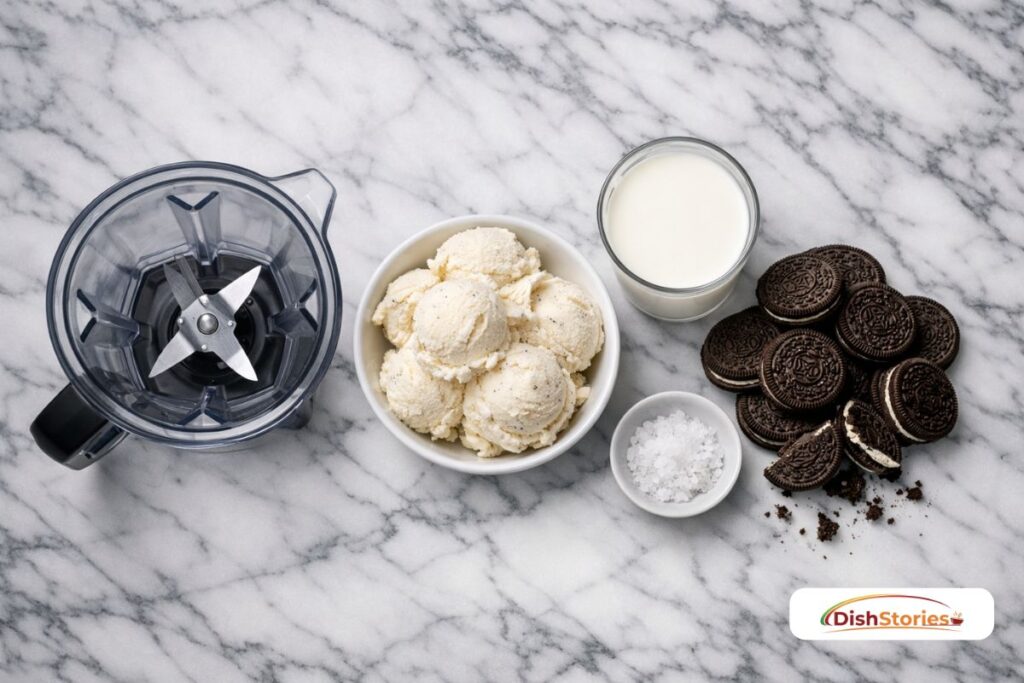
A shake this precise demands tools that respect the physics involved.
The Blender: Torque Over Speed
Not all blenders are equal. What matters here is torque, not just blade speed.
High-performance machines like those from Vitamix or Wolf Gourmet are engineered to:
- Process dense mixtures without stalling
- Maintain low friction (reducing heat generation)
- Create consistent particle distribution
Lower-powered blenders often compensate with speed, which introduces heat—melting the ice cream prematurely and destabilizing the emulsion.
In short: a weak blender forces you to sacrifice thickness.
The Architecture of the Glassware
The vessel is not passive—it is a thermal instrument.
Glass, unlike plastic, possesses higher thermal conductivity and mass, allowing it to function as a heat sink. When properly chilled, a thick-walled soda fountain glass—such as those manufactured by Libbey—absorbs ambient heat before it can reach the shake itself. This delays structural degradation in a way that is both measurable and sensory.
Thin plastic cups, by contrast, insulate poorly and warm quickly. The result is a rapid collapse of viscosity, often within minutes.
A double-walled, vacuum-insulated tumbler goes even further, minimizing heat transfer entirely. However, it sacrifices the tactile ritual of glass—the condensation, the weight, the visual density of the shake.
In practice, a properly chilled, heavy glass can preserve the shake’s integrity for up to 15 minutes longer than inferior alternatives. That is the difference between a drink that endures and one that dissolves mid-experience.
The Cocoa Chemistry of the Oreo
The Oreo wafer is not just chocolate—it is alkalized cocoa (Dutch-processed), which has a higher pH than natural cocoa.
This matters because:
- Alkalinity reduces bitterness
- It interacts differently with dairy proteins
- It produces a smoother, less acidic flavor profile
When combined with milk and cream, this cocoa creates a rounded, almost malty depth—distinct from sharper chocolate notes.
Adding a pinch of salt amplifies this effect, not by making the shake “salty,” but by modulating taste perception at a molecular level.
The Garnish Engineering: Rimming the Glass
Garnish is often treated as decoration. Here, it becomes function.
Rather than scattering crumbs across the surface—where they quickly hydrate and disappear—the Rim Emulsion Technique introduces flavor at the point of contact.
Begin with your pre-chilled glass. Dip the rim into a thin layer of melted dark chocolate or peanut butter, both of which act as adhesive fats. Then roll the coated rim in finely crushed Oreo dust.
What forms is a textural interface—a concentrated ring of flavor that engages before the shake even reaches the palate.
Each sip passes through this rim, picking up:
- Cocoa intensity
- Fat-enhanced aroma
- A slight granular contrast
The result is a layered tasting experience: first the rim, then the shake, then the lingering blend of both.
It is not garnish. It is engineered introduction.
The Master Recipe: The “Two-Stage” Oreo Thick Shake
Oreo Milkshake Recipe
Equipment
- 1 High-speed blender
- 1 chilled stainless steel straw,
- 1 tall heavy-base glass
Ingredients
- 4 massive scoops approx. 2 cups super-premium vanilla bean ice cream
- 1/2 cup organic whole milk cold
- 8 Oreo cookies separated: 4 for the base, 4 for the fold-in
- 1/4 tsp flaky sea salt the “flavor multiplier”
- Optional: homemade whipped cream not canned
Instructions
Pre-Chill
- Place your blender jar and glass in the freezer for 10 minutes. Cold equipment is non-negotiable.
The Base Layer
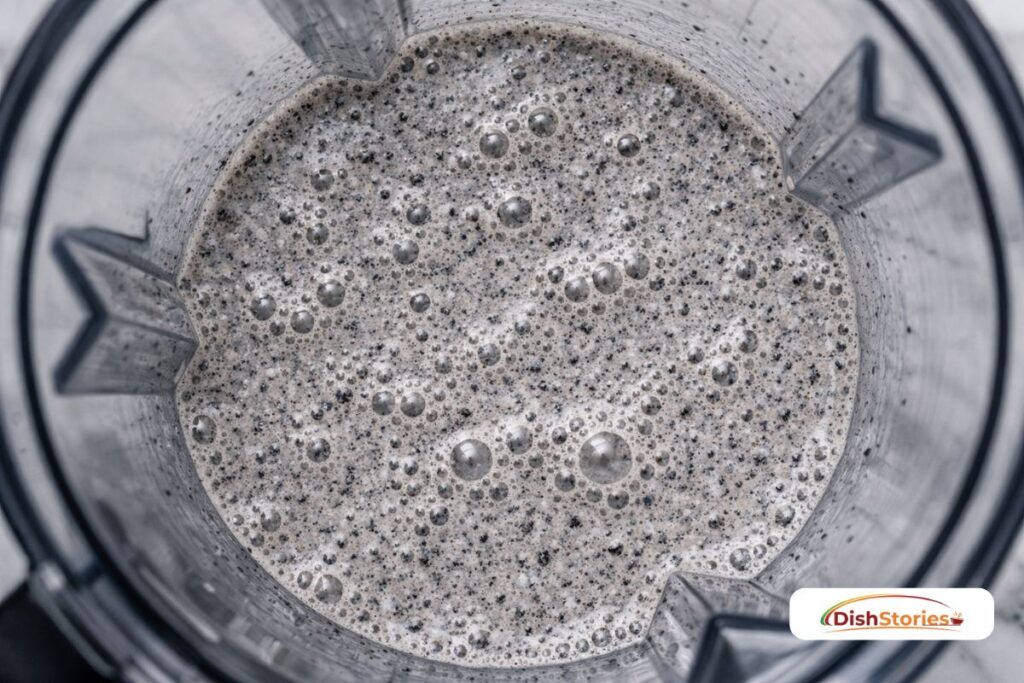
- Add milk, 4 Oreos, and the salt to the blender. Pulse until the cookies are reduced to a fine “dust.” This step infuses the liquid with deep cocoa flavor.
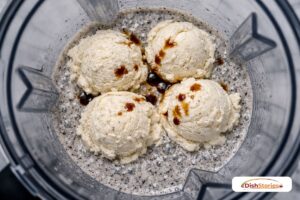
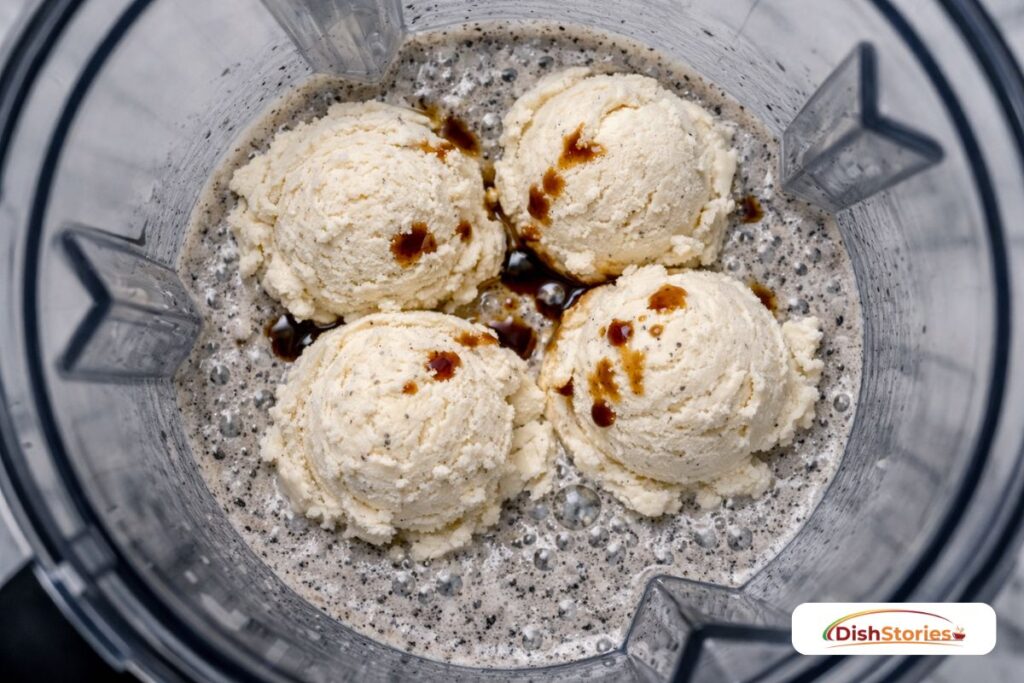
The Emulsion
- Add the ice cream. Blend on the lowest setting for 15 seconds. Avoid high speed—friction generates heat, which weakens the structure.

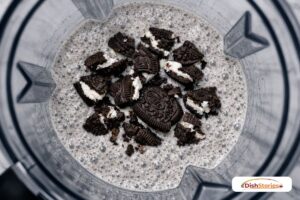
The Texture Fold
- Add the remaining 4 Oreos. Pulse exactly 3 times. You’re aiming for irregular “pebbles,” not uniform powder.
The Rim Detail
- While the blender sits, dip the rim of your chilled glass into a shallow plate of melted chocolate (or peanut butter), then into a plate of finely crushed Oreo dust to create a uniform coating.Note: See the 'Garnish Engineering' section above for the science of why this rim technique improves flavor perception.
The Finish
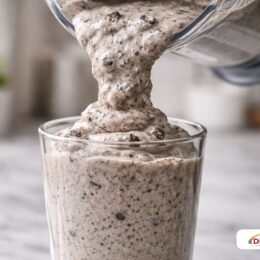
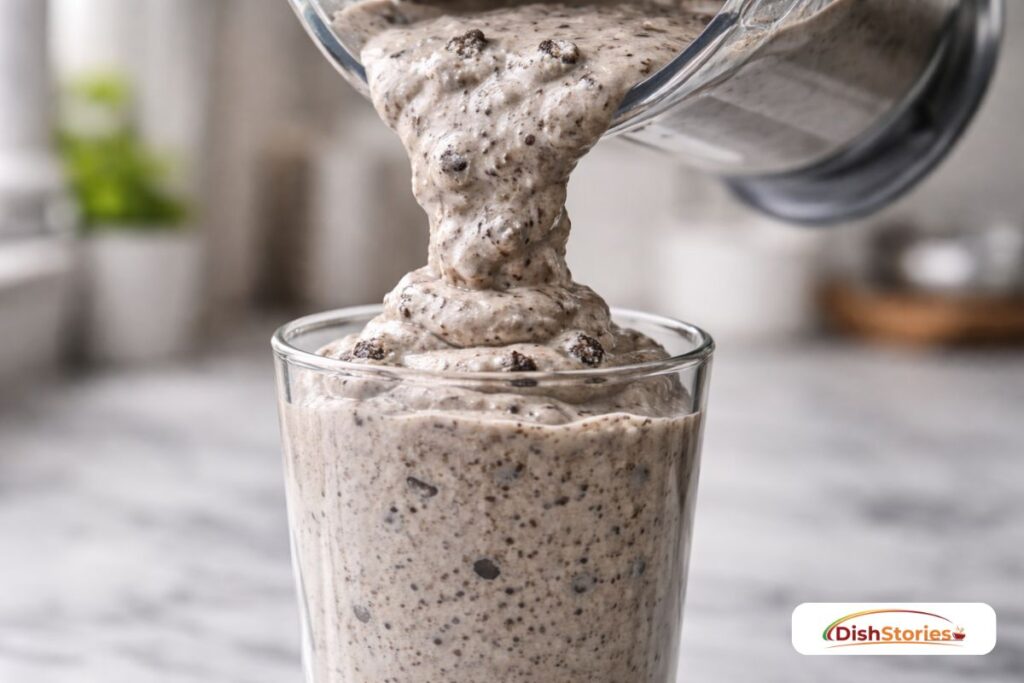
- Pour into the chilled glass. Serve immediately with a chilled straw. No delay—the structure begins to relax the moment it’s poured.
Video
Notes
Nutrition (Per Serving)
- Calories: 840 kcal
- Fat: 42g
- Carbohydrates: 98g
- Protein: 12g
- Sugar: 65g
Culinary Science Note
Culinary Science Note: A perfect thick shake is a temporary foam emulsion. The air bubbles trapped during the churn are stabilized by the fat globules in the cream and the lecithin in the egg yolks. Adding a pinch of salt doesn’t just “salt” the shake; it suppresses the bitterness of the dark cocoa in the cookies, allowing the vanilla’s aromatic vanillin to become more volatile and perceptible to the palate.
Pairings & Texture Inspirations
For those interested in exploring texture across different formats:
- The Velvet Sunset Mango Smoothie offers a contrasting example of fruit-based emulsions and how fiber alters viscosity.
- The Ultimate Guide to No-Bake Cookies provides complementary snacks that mirror the Oreo’s structural role—crumbly, fatty, and flavor-dense.
- To create a complete ‘Modern Heirloom’ dessert experience, I recommend serving this shake alongside a batch of our Pastel Soft-Batch Sugar Cookies. The light, vanilla-forward notes of the cookies provide a sophisticated balance to the heavy, cocoa-rich emulsion of the shake.
- Beyond sweet pairings, this dense dairy emulsion serves a functional role in high-spice culinary traditions. In the same way a lassi functions in South Asian cuisine, serving this thick shake after a complex Chicken Kabsa Biryani provides an immediate ‘palate recovery.’ The high fat content of the whole milk and ice cream binds to capsaicin molecules, offering a sophisticated, cooling finish to an intensely aromatic meal.
Aspiring culinary scientists can find detailed breakdowns of frozen dessert physics through programs at the Culinary Institute of America, which specialize in the mechanics of density. For those requiring the exact industrial metrics used to stabilize emulsions through air incorporation, the University of Guelph’s Ice Cream Technology guide remains the premier technical resource.
Strategic FAQ Oreo Milkshake Recipe
Can I make this without a blender?
Yes—but you’ll sacrifice some structural precision.
The Mason Jar / Whisk Method:
1. Finely crush Oreos using a rolling pin
2. Whisk cold milk and cookie dust vigorously
3. Fold in softened ice cream manually
This method creates a looser emulsion and less uniform texture, but it can still approximate a homemade Oreo milkshake.
Why does my shake separate?
Separation occurs when the emulsion breaks. Common causes include:
Excess heat from over-blending
Warm equipment causing uneven melting
Low-fat ice cream lacking structural stability
Once broken, the fat and water phases begin to split, resulting in a thin, uneven drink.
Are Oreos vegan?
Oreos are often described as “accidentally vegan.” They contain no direct animal products, but may have cross-contact with dairy during manufacturing.
However, this recipe is not vegan due to the ice cream and milk. Substitutions would require plant-based equivalents with similar fat content and density.
How can I make this a “boozy” shake?
Alcohol introduces both flavor and chemical complexity.
Effective additions include:
– A splash of bourbon (enhances vanilla notes)
– Coffee liqueur (deepens cocoa profile)
Add no more than 1–1.5 oz. Excess alcohol lowers freezing point and thins the shake, compromising structure.