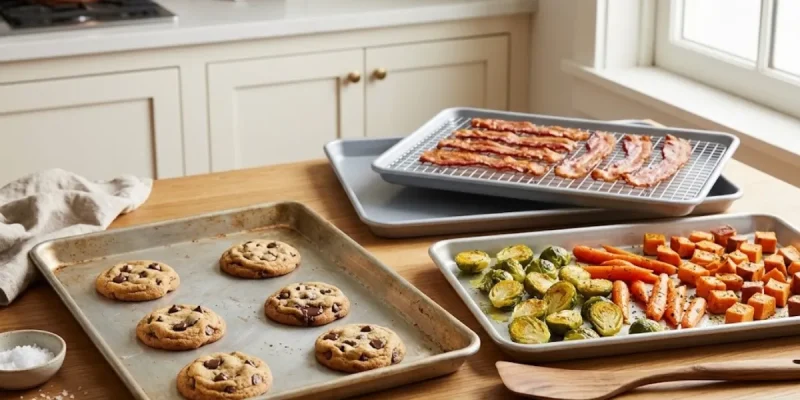
Best Sheet Pans for Baking, Roasting & Everyday Cooking
If you’ve ever heard a sudden POP from the oven and opened the door to find your sheet pan bowed in the middle, you know how quickly a cheap pan can turn into a kitchen headache.
A warped pan doesn’t just look ugly. Food can slide toward one corner, oil can pool where you don’t want it, and delicate baked goods can brown unevenly. When you’re roasting vegetables at 425°F or baking a full batch of cookies, the pan underneath your food matters more than most people realize.
We’ve spent time cooking with and comparing sheet pans with those everyday problems in mind. We looked beyond specifications to see how the pans behave under high heat, how they handle heavier foods, how their surfaces change with use, and how much work they create at cleanup time.
For most home cooks, a sturdy half-sheet pan is the most useful size to own. But the best choice depends on what you cook most often.
Best Sheet Pans at a Glance
| Category | Top Pick | Material | Key Feature |
|---|---|---|---|
| Best Overall | Nordic Ware Natural Aluminum Commercial Half Sheet | Bare Aluminum | Excellent heat response and reinforced rim |
| Best Budget | Winco Commercial Grade 18-Gauge Half Sheet | 3003 Aluminum | Commercial-style durability at a low price |
| Best Heavy-Duty | USA Pan Bakeware Half Sheet | Aluminized Steel | Rigid construction and textured surface |
| Best for Baking | Vollrath Wear-Ever Heavy-Duty Half Sheet | Heavy-Gauge Aluminum | Substantial construction for consistent baking |
| Best for Roasting | Great Jones The Holy Sheet | Coated Steel | Heavy construction and easy handling |
| Best Nonstick | Calphalon Premier Countertop Nonstick Sheet | Nonstick-Coated Steel | Easy food release and convenient cleanup |
| Best Stainless Steel | TeamFar Stainless Steel Baking Sheet | Stainless Steel | Durable, non-coated cooking surface |
What Is the Best Sheet Pan?
Our Top Pick: Nordic Ware Natural Aluminum Commercial Half Sheet
Best for: Everyday baking, roasting, and sheet-pan dinners.
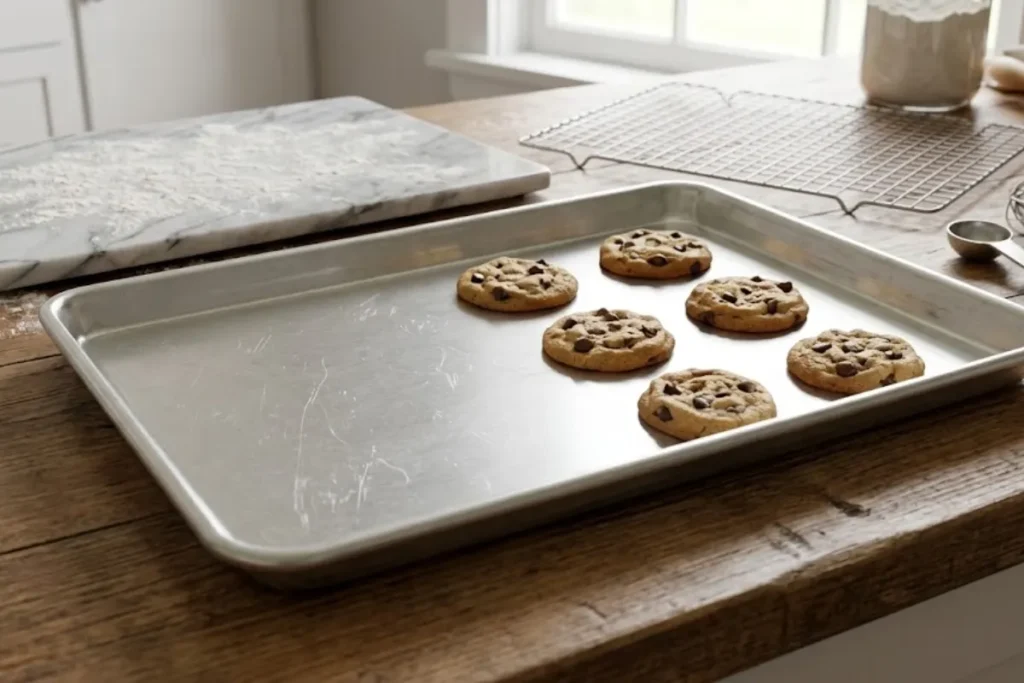
The Nordic Ware Natural Aluminum Commercial Half Sheet is the pan we’d reach for first when we want one sheet pan to handle almost everything.
Its bare aluminum construction is the main reason. Aluminum responds quickly to oven heat and distributes that heat efficiently, making it particularly well suited to cookies, roasted vegetables, and other foods where predictable browning matters. The reinforced rim adds rigidity without turning the pan into something excessively heavy.
After repeated baking and roasting, what stands out is how straightforward this pan feels. There’s no coating to worry about scratching, no elaborate surface treatment to maintain, and no strange learning curve. Put food on it, cook, wash it, and put it back in the cupboard.
The pan also develops character with use. Bare aluminum doesn’t stay showroom-perfect forever. It gradually darkens and develops a patina, particularly around areas exposed to oil and high heat. That’s cosmetic rather than a sign that the pan has failed.
The main maintenance warning is the dishwasher. Harsh dishwasher detergents can discolor bare aluminum, so hand washing is the better long-term habit.
DishStories verdict: The best combination of heat response, durability, versatility, and value for most home cooks.
Other Best Sheet Pans
Best Budget Sheet Pan: Winco Commercial Grade 18-Gauge Half Sheet
Best for: Everyday cooking when price matters.
- Material: 3003 aluminum
- Size: 18 × 13 inches
- What we like: Commercial-grade construction and reinforced rim
- Potential drawback: Bare aluminum scratches and discolors more easily than coated surfaces
- Our verdict: A remarkably practical workhorse for the money.
The Winco has the unmistakable feel of commercial kitchen equipment. It isn’t trying to look luxurious. It is built to be used.
Its 18-gauge 3003 aluminum construction gives it a substantial feel, while the reinforced bead helps keep the perimeter rigid. When loaded with a heavy meal, that rigidity matters because you’re less likely to feel the pan flex dramatically when moving it from the oven to the counter.
The edge isn’t quite as polished-feeling as some premium consumer bakeware, but that’s a small trade-off at this price.
DishStories testing note: When evaluating a budget pan, pay particular attention to how it handles a fully loaded tray. A cheap pan that flexes badly under weight becomes much less attractive once you’re carrying hot chicken and roasting juices across the kitchen.
Best Heavy-Duty Sheet Pan: USA Pan Bakeware Half Sheet
Best for: Heavy roasting and frequent oven use.
- Material: Aluminized steel with coated surface
- Size: Half sheet
- What we like: Rigid construction and textured cooking surface
- Potential drawback: Heavier than standard aluminum
- Our verdict: A good choice for cooks who want a more substantial pan.
The first thing you notice when handling a heavy-duty sheet pan is the difference in heft.
That extra substance can be reassuring when you’re roasting a large batch of chicken, potatoes, or root vegetables. The pan feels less like a lightweight baking tray and more like equipment designed to stay put.
The textured surface is another distinctive feature. It adds character to the pan, but the real question is how it performs with your food. During testing, pay attention to whether roasted foods release easily and whether browned residue collects in the texture.
Best Sheet Pan for Baking: Vollrath Wear-Ever Heavy-Duty Half Sheet
Best for: Cookies, pastries, and frequent baking.
- Material: Heavy-gauge aluminum
- Size: Half sheet
- What we like: Thick aluminum construction and consistent heat response
- Potential drawback: More expensive than basic aluminum
- Our verdict: An excellent option for serious home bakers.
The Vollrath has the substantial feel you’d expect from heavy-duty commercial bakeware.
That thickness changes how the pan behaves in the oven. Rather than being an ultra-light tray that heats almost instantly, it has more thermal mass. For delicate baked goods, that can help produce a more controlled baking environment.
We particularly like this type of construction for cookies where bottom browning is the difference between a beautifully baked batch and one that tastes slightly too toasted.
If you’re testing this pan against thinner trays, use the exact same cookie dough and oven temperature. Look at the bottom of the cookies as carefully as the tops. That’s where differences between pans become easiest to see.
Best for Roasting: Great Jones The Holy Sheet
Best for: Roasted vegetables and complete sheet-pan dinners.
- Material: Coated steel
- Size: Half-sheet style
- What we like: Substantial construction and attractive design
- Potential drawback: Coated surface requires more careful maintenance
- Our verdict: A stylish option that still has practical roasting credentials.
The Great Jones The Holy Sheet is particularly appealing if your sheet pan spends most of its life roasting vegetables and complete dinners.
A heavy pan can hold onto heat well when you load it with cold ingredients. That matters when you’re trying to get deep browning on broccoli, Brussels sprouts, potatoes, or other vegetables.
The key is not simply how hot the pan gets. It’s whether the food has enough contact with the hot surface to brown rather than steam.
Best Nonstick Sheet Pan: Calphalon Premier Countertop Nonstick Sheet
Best for: Sticky foods and easy cleanup.
- Material: Heavy-gauge nonstick-coated construction
- Size: Countertop-safe format
- What we like: Easy food release
- Potential drawback: Coating requires careful maintenance
- Our verdict: The convenient choice for cooks who hate scrubbing baked-on residue.
Nonstick earns its place when the food itself is difficult.
Sticky glazes, melted cheese, sugary sauces, and roasted foods can create a stubborn layer on bare metal. A quality nonstick surface can turn cleanup from a scrubbing session into a quick wash.
The trade-off is that you have to treat the surface properly. Avoid metal utensils and abrasive cleaners, and stay within the manufacturer’s temperature recommendations.
Best Stainless Steel Sheet Pan: TeamFar Stainless Steel Baking Sheet
Best for: Cooks who prefer a durable, non-coated surface.
- Material: Stainless steel
- Size: Half-sheet style
- What we like: Durable surface and easy everyday maintenance
- Potential drawback: Different heat behavior from aluminum
- Our verdict: The best fit for cooks who specifically want stainless steel.
Stainless steel is attractive for sheet-pan dinners involving lemon, tomato, vinegar, or other acidic ingredients.
Unlike bare aluminum, stainless steel provides a non-reactive cooking surface. It also avoids the question of whether a nonstick coating will eventually wear.
The compromise is heat conductivity. If you’re accustomed to baking on aluminum, don’t expect stainless steel to behave identically. For recipes where precise browning matters, that difference is worth considering.
How We Chose the Best Sheet Pans
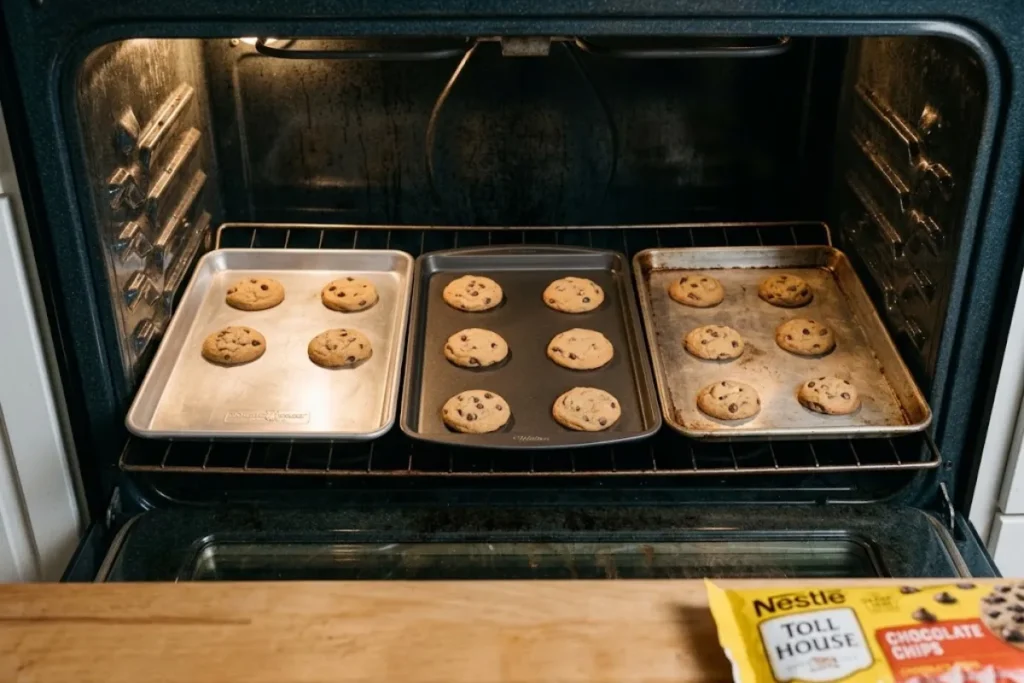
We didn’t judge these pans by specifications alone. A gauge number doesn’t tell you how a pan feels when it’s full of chicken, and a marketing claim about nonstick release doesn’t tell you how the surface behaves after a sticky roast.
Our evaluation focused on five things.
1. High-Heat Roasting
We used high-temperature roasting to look for:
- Warping
- Uneven browning
- Surface sticking
- Rim rigidity
- Handling when fully loaded
A sheet pan should remain predictable when the oven gets hot.
2. Delicate Baking
Cookies provide a useful test because they’re sensitive to heat distribution.
We compared bottom browning, edge color, spread, and overall consistency.
3. Heavy Loads
A pan can feel perfectly rigid when empty and completely different when loaded with several pounds of food.
We paid attention to flexing, rim strength, and how comfortable each pan was to carry.
4. Cleanup
After roasting, we looked at how much residue remained and how easily it came away with normal cleaning.
We also paid attention to annoying details that rarely appear in product descriptions, such as water collecting around reinforced rims.
5. Long-Term Use
Durability isn’t just about whether a pan survives the first few recipes. We looked for changes in:
- Surface color
- Scratches
- Warping
- Coating condition
- Rim integrity
For additional context on how professional cookware testing evaluates baking sheets, Serious Eats’ guide to sheet pans is a useful independent reference.
Sheet Pan Materials Explained
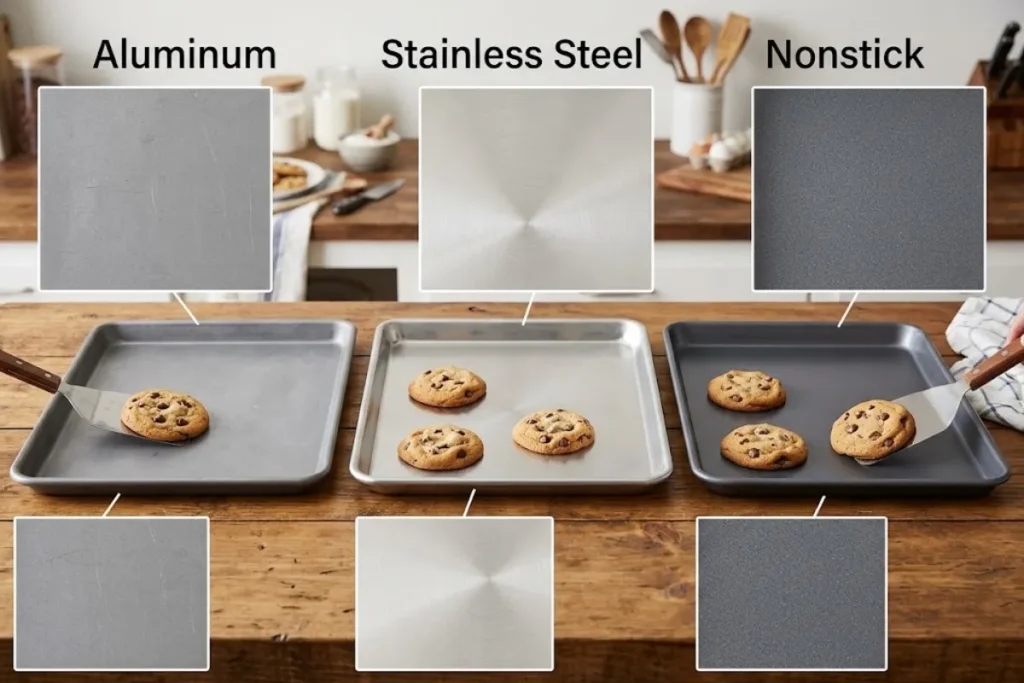
Bare Aluminum
Bare aluminum remains one of the best choices for baking.
It heats efficiently, is relatively lightweight, and doesn’t rely on a coating. That’s why you’ll see it everywhere from home kitchens to professional bakeries.
The downside is appearance. Aluminum naturally darkens and develops a patina. Don’t confuse that with poor performance.
Stainless Steel
Stainless steel is durable, non-reactive, and easy to live with.
Its main weakness is heat conductivity. It doesn’t respond to oven heat the same way aluminum does, which can affect browning.
Aluminized Steel
Aluminized steel combines a steel base with aluminum.
The result is a stronger, more rigid construction that can make sense for heavy roasting.
Nonstick and Ceramic-Coated
Coated pans are about convenience.
They’re particularly useful when food release and cleanup matter more to you than having a bare-metal surface.
Just remember that coatings have a finite lifespan and require appropriate care.
What Size Sheet Pan Should You Buy?
For most US home kitchens, buy a half sheet first.
Full Sheet
Approximately 26 × 18 inches. Primarily designed for commercial kitchens and too large for many residential ovens.
Half Sheet
Approximately 18 × 13 inches.
This is the workhorse size. It’s large enough for cookies, vegetables, chicken, and sheet-pan dinners without being unwieldy.
Quarter Sheet
Approximately 13 × 9 inches.
Useful for smaller servings, side dishes, and smaller ovens.
Jelly Roll Pan
A smaller rimmed baking pan commonly used for rolled cakes and other baked goods.
Our recommendation: If you’re starting from scratch, buy two quality half sheets. You’ll use them far more often than specialized sizes.
Sheet Pan vs. Baking Sheet: What’s the Difference?
The terminology can be confusing because retailers and cooks don’t always use the names consistently.
A sheet pan generally has a raised rim around all four sides. That’s what makes it useful for roasting because oil, juices, and marinades stay contained.
A rimless baking sheet is designed to make it easy to slide cookies and other baked goods onto a cooling rack.
For an all-purpose kitchen, choose the rimmed sheet pan.
Best Sheet Pan for Different Foods
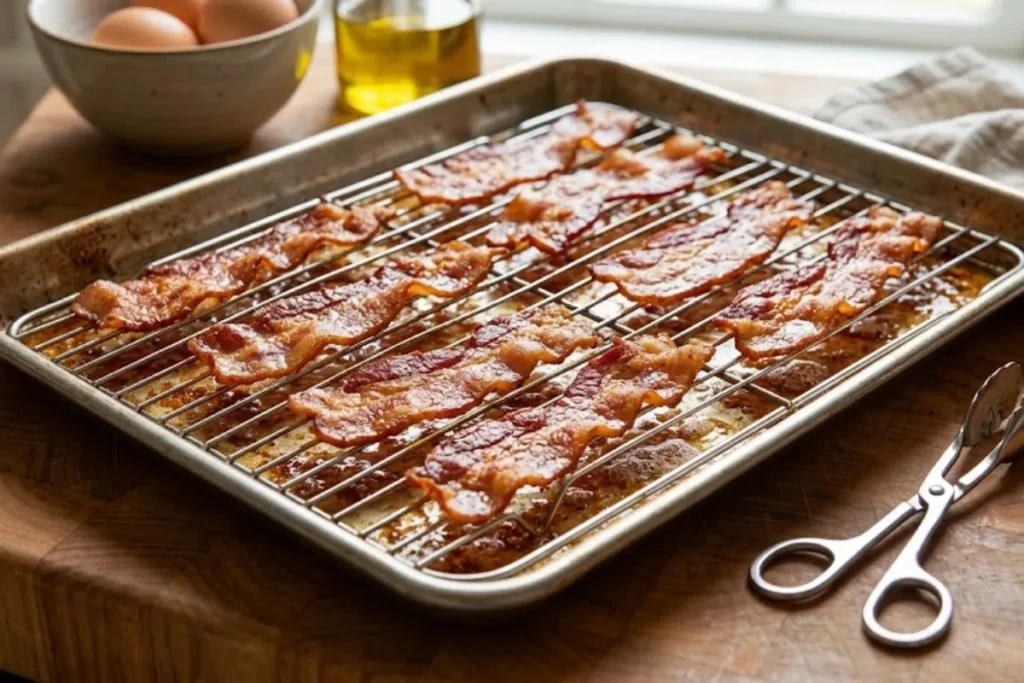
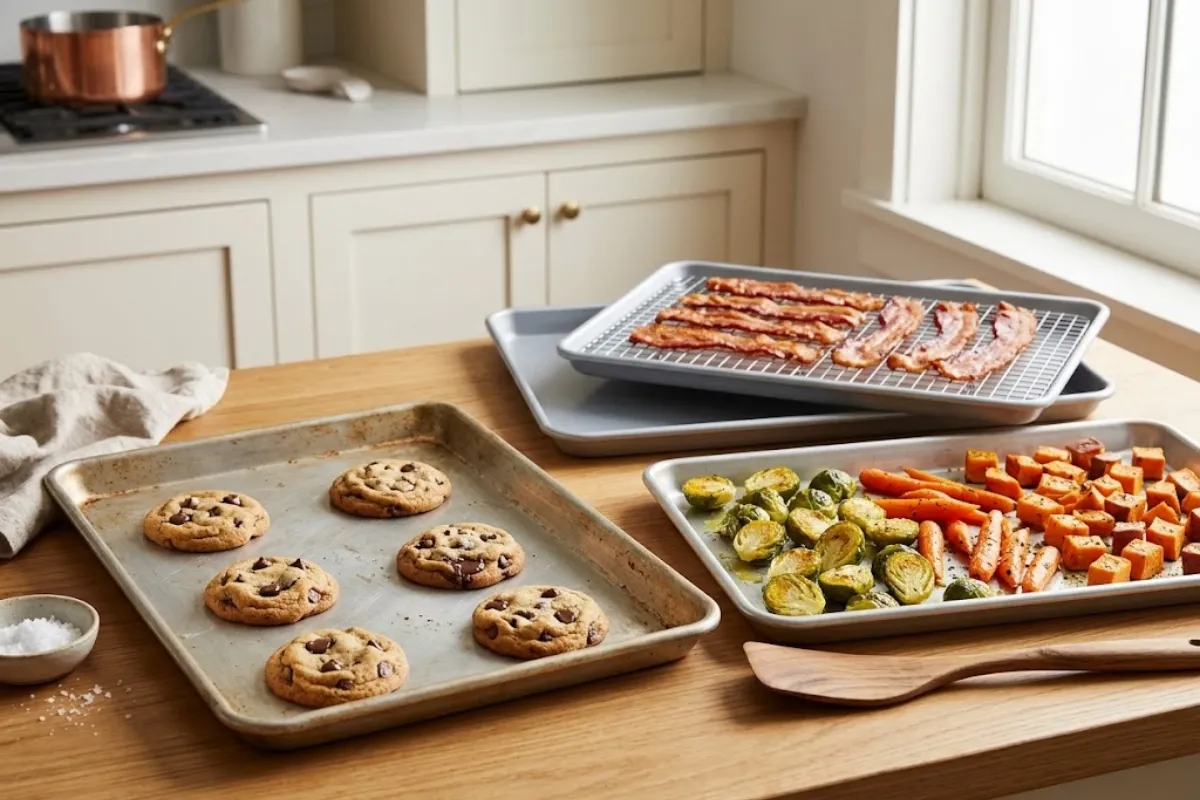
Crispy Bacon
For oven bacon, use a rimmed sheet pan so the rendered fat stays contained. Adding a wire rack allows air to circulate around the bacon for more even crisping.
Try the technique with our Perfect Crispy Bacon in the Oven.
Roasted Vegetables
This is where pan size becomes critical. Spread vegetables into a single layer with room between pieces. Crowding creates steam and works against the browned edges you’re trying to develop (following Serious Eats’ core rules for sheet pan dinners). Try it with our Oven Roasted Asparagus.
Sheet Pan Chicken
Chicken plus vegetables creates a substantial load, so a rigid half sheet is particularly useful.
For a complete dinner, see our Lemon Garlic Chicken Sheet Pan Recipe.
Bakery-Style Cookies
For cookies, a light-colored aluminum pan is an excellent starting point. It provides predictable heat response without the aggressive browning that can happen with some darker surfaces.
Put your pan to work with our Bakery Style Chocolate Chip Cookies.
How to Prevent Sheet Pans From Warping
That dramatic oven POP is usually the result of uneven thermal expansion.
When one part of the metal heats faster than another, the pan can temporarily buckle.
You can reduce the risk by:
- Letting hot pans cool before washing.
- Avoiding sudden temperature changes.
- Choosing pans with reinforced rims.
- Using the pan within its recommended temperature range.
- Avoiding extremely thin bargain pans for repeated high-heat cooking.
If you regularly roast at 425°F or higher, construction matters. A sturdier pan is usually worth the extra few dollars.
How to Clean and Maintain Sheet Pans
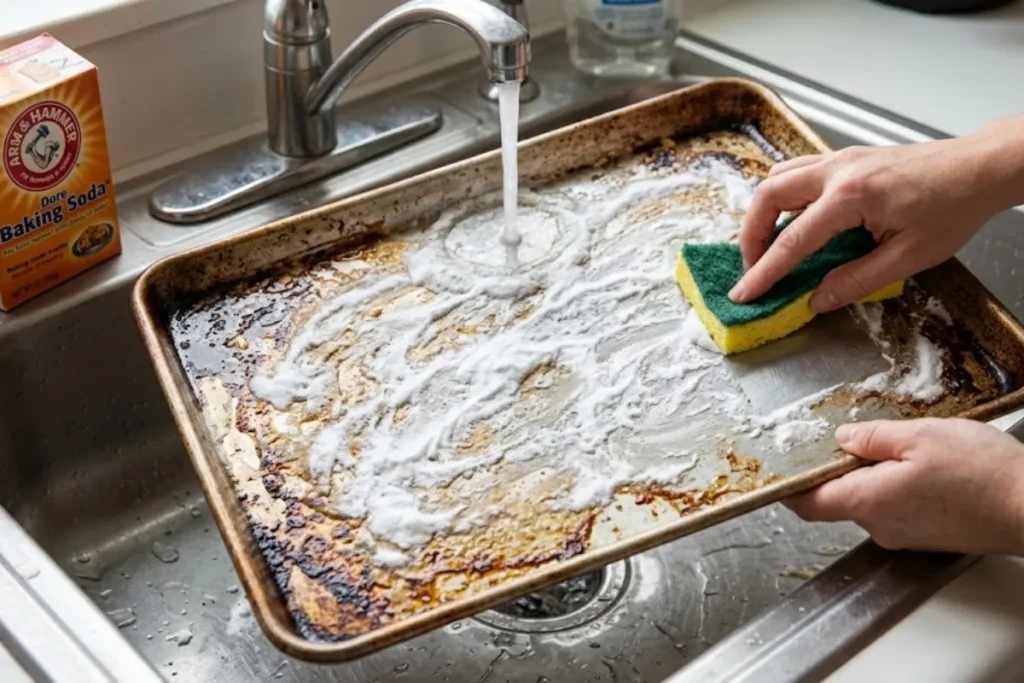
For bare aluminum, use warm water, mild dish soap, and a non-abrasive sponge.
Don’t worry if the pan gradually loses its bright silver appearance. That’s normal for frequently used aluminum bakeware.
For stubborn grease, start with a baking soda paste and allow it to loosen the residue before scrubbing gently. A nylon pan scraper is also useful for removing stuck-on food without attacking the metal.
Avoid putting bare aluminum through the dishwasher if you want to minimize discoloration.
For nonstick pans, follow the manufacturer’s cleaning instructions and avoid abrasive tools.
One small but surprisingly annoying detail: reinforced rims can sometimes retain water after washing. Store the pan vertically or allow it to drain completely before stacking it away.
Frequently Asked Questions
What is the best material for a sheet pan?
For most home cooks, bare aluminum is the best all-around choice. It heats efficiently, works beautifully for baking and roasting, and is generally affordable.
Are aluminum sheet pans safe to cook on?
Yes. Aluminum sheet pans are widely used for baking and roasting. For strongly acidic foods, parchment provides a convenient barrier and makes cleanup easier.
Why do sheet pans pop in the oven?
The sound comes from uneven thermal expansion. As different areas of the metal heat at different rates, the pan can suddenly flex or buckle.
Can sheet pans go in the dishwasher?
It depends on the material. Stainless steel is often dishwasher-safe, while bare aluminum may discolor from dishwasher detergents. Nonstick pans should follow their manufacturer’s care instructions.
What size sheet pan is best for home cooking?
A half sheet, roughly 18 × 13 inches, is the most useful size for most home cooks. It works for cookies, roasted vegetables, chicken, bacon, and complete sheet-pan dinners.
Final Verdict
For most home kitchens, you don’t need a collection of specialty pans.
Start with two quality half-sheet pans.
Our top choice is the Nordic Ware Natural Aluminum Commercial Half Sheet because it combines efficient heat transfer, a practical size, sturdy rim construction, and long-term versatility without relying on a nonstick coating.
If you’re watching the budget, Winco gives you commercial-style construction for considerably less. If you prefer a heavier pan, USA Pan is worth considering. Frequent bakers may appreciate Vollrath’s substantial aluminum construction, while stainless-steel fans have a strong alternative in TeamFar.
The best sheet pan isn’t necessarily the most expensive one or the one with the longest specification sheet.
It’s the pan that stays flat when the oven gets hot, browns your food predictably, doesn’t make cleanup miserable, and still feels dependable after you’ve used it dozens of times.
That’s what earns a permanent place in the kitchen.