It began with a memory. (I wanted to recreate the perfect Arabic Kunafa, Middle Eastern dessert at home.)
Not a memory of a place, but a taste. The faint, warm sugar-soaked scent of the pastry my grandmother pulled from the tray on lazy, golden afternoons in Beirut. That crunchy-then-melting bite, the subtle tang of cheese clinging to thin threads of dough, and the perfumed whisper of orange blossom syrup. It wasn’t just dessert—it was a texture, a feeling, a heartbeat translated into food. And yet, every time I tried to recreate it in my kitchen, the edges burned before the center set, the syrup either puddled or crystallized, and the dough… oh, the dough, it refused to be tamed.
So I opened my notebook. Pen to paper, hands flour-streaked, late-night kitchen lights flickering. This was not going to be a copy. This was going to be a reinvention—a wild, messy, exploratory journey toward the ultimate Arabic Kunafa recipe (Knafeh recipe).
The Spark
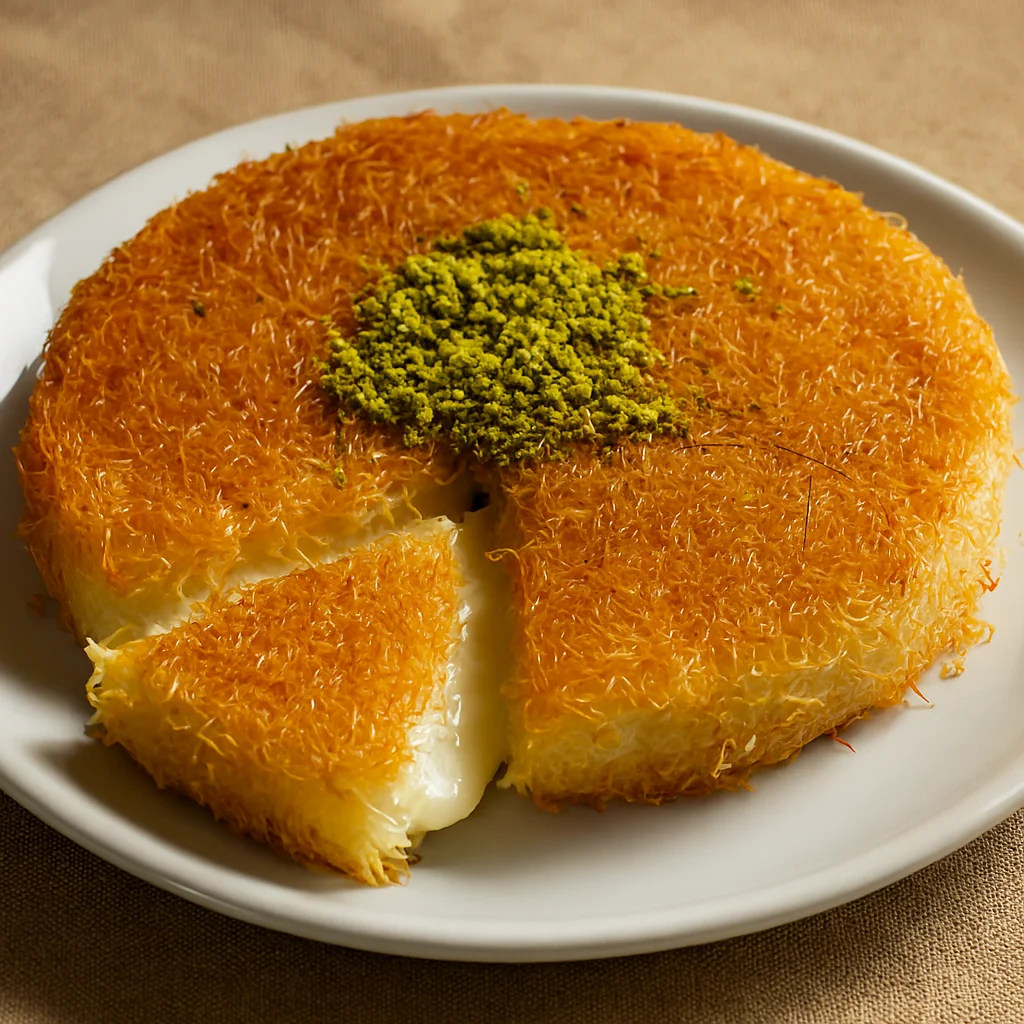
I remember pacing the kitchen at 1:47 a.m., staring at strands of homemade Kunafa dough splayed across the counter like golden hay. I had been playing with the idea of a cheese Kunafa that maintained the delicate crunch of traditional Kataifi but also achieved a melt-in-your-mouth center without collapsing into a sticky mess. The spark? A tiny accident with strained labneh in place of Nabulsi cheese. I tasted it. Sharp, creamy, almost daringly unstructured.
“What if texture was layered, not just baked?” I scribbled.
“What if syrup wasn’t a soaking agent but a flavor punctuation?”
I knew this combination—a nutty, buttery exterior; molten, tangy interior; and sweet, aromatic syrup—was worth chasing. And thus, armed with curiosity and a little stubbornness, I dove into the first round of experiments.
The Experiments
Batch 1: Overcooked strands.
Notes: Crunchy at edges, chewy and raw in the middle. Syrup overwhelmed. Thought: Maybe the dough is too dense; maybe I’m frying when I should be baking.
Batch 2: Under-baked strands.
Notes: Molten cheese perfect. Dough floppy. Syrup sits on top like a syrupy lake. Frustration sets in. Note to self: “Do not cry over sweet cheese. Yet.”
Batch 3: Strained labneh + butter + semolina strands.
Observation: Dough spreads unevenly, forms clumps. Flavor: Nutty, slightly tangy, notes of browned butter. Moment of doubt: Is this even Kunafa anymore?
(Side note scribbled in margins: “Remember, experimentation is messy. This is not failure. This is data in flour and cheese form.”)
I began adjusting temperature like tuning an instrument. First low, then medium, then daringly high. Each shift produced unexpected reactions: strands curling, syrup bubbling, cheese stretching into impossible ribbons. I learned quickly: timing was everything. Five minutes too long and the texture collapsed; five too short and the dough was raw.
I experimented with Kunafa without oven techniques. Pan-frying in butter, pressing dough with weights, flipping like a delicate crepe. Notes: smoky aroma, surface golden-brown, bottom slightly caramelized. A revelation: stove-top Kunafa yields a flavor profile impossible in the oven alone.
I also tested acidity. Lemon in syrup gave brightness, but too much made the cheese curdle. Orange blossom water? Essential. Perfumed without overpowering. Rose water? Romantic, yes, but clashed with the nuttiness.
At some point, I wrote in all caps across the page: “THE CHEESE IS THE HERO. EVERYTHING ELSE IS SUPPORTING CAST.”
Flavor & Texture Notes
- Batch 4 Notes: Threads separate beautifully, smell like toasted almonds, buttery. Cheese slightly too firm.
- Texture Observation: Crisp outside, molten inside—but edges need stability. Consider butter-sprinkling between layers.
- After 3 hours resting: Dough absorbs just enough syrup. Surface remains crisp. Cheese flavor develops depth.
- Unexpected reaction: Butter + semolina strands + medium heat = slightly caramelized edges. Aroma: intoxicating.
- Next tweak: Introduce small pinch of fine salt in syrup to cut sweetness. Add gentle press during pan-fry to stabilize layers.
Balancing Challenges
Ah, the cruel realities:
- Overpowering spices: A hint of cardamom overwhelmed everything. Lesson: minimalism wins. Aroma subtlety is key.
- Wrong heat level: Pan too hot = burnt edges, raw center. Pan too low = dough soggy, cheese stiff. Precision is everything.
- Ingredient clash: Labneh + rose water = flavor fight. Labneh + orange blossom water = harmonious.
- Timing problems: Syrup must cool slightly before application, but not too long. The chemistry is delicate.
- Texture inconsistencies: Strands must be fluffed, never pressed too hard before frying. Butter between layers stabilizes without sogginess.
Each mistake revealed hidden truths. Each error was a breadcrumb toward clarity. The kitchen smelled like sugar, burnt butter, and triumph—often simultaneously.
Breakthrough Moment
It happened at 2:03 a.m., in a kitchen lit by one flickering bulb. I had layered the spun dough with cheese, sprinkled butter, and pressed gently. Pan on medium flame. Syrup cooling beside me. I flipped the Kunafa with a spatula, and—oh, that sound—crackly, delicate, caramelized.
I tasted. The outside, a golden crunch, nutty, slightly smoky. The inside, molten, slightly tangy, with just a whisper of salt. Syrup kissed, not drowned. Orange blossom perfume threaded through.
Pause. Take a breath. Tears? Maybe. Relief? Definitely. The Arabic Kunafa recipe had finally come to life in the way I had been chasing: bold, precise, messy, unapologetically delicious.
Scribbled Recipe Observations
- Batch 5 Notes: Cheese pulls into perfect ribbons. Dough crunchy, golden. Aroma: hypnotic.
- After slight syrup drizzle: Dough resists sogginess. Flavor balance perfect.
- Texture Observation: Each bite: crunch, stretch, sweetness, tang. Mouth dancing.
- Next tweak: Slightly increase orange blossom water for aroma boost, but just a whisper.
Reflection: Creativity, Mistakes, and Food
The journey to the ultimate Arabic Kunafa recipe reminded me why we cook beyond recipes. Each failure, each burnt edge, every sticky mess of dough was a teacher. I learned that control is a myth; experimentation is the true mastery. I learned patience is as much chemical as emotional. I learned that creativity thrives in the messy margins—flour-dusted countertops, sticky fingers, and half-formed ideas scribbled in a notebook.
The dish itself embodies life’s contradictions: crisp yet soft, sweet yet tangy, chaotic yet precise. Every trial taught me not just about flavors and textures but about courage, curiosity, and the beauty of embracing imperfection.
So here’s my note to any home cook, any curious experimenter: be brave. Fail. Taste. Adjust. Play. The next breakthrough could be sitting on your counter, waiting for you to flip, taste, and scribble, “Yes. This is it.”
History and varieties of Kunafa – TasteAtlas
Chef’s Notebook: The Takeaway
The Arabic Kunafa recipe is more than a dessert. It’s a meditation on experimentation. On noticing tiny reactions in heat, flavor, and texture. On learning to trust intuition and abandon perfection. On the thrill of discovery at 2 a.m., alone with sugar, butter, and curiosity.
If you approach it with that mindset, it becomes not just a recipe, but a conversation—between you, the ingredients, and the possibility of joy in each bite.
Arabic Kunafa Recipe
Arabic Kunafa
Equipment
- 1 Large mixing bowl
- 1 Skillet or shallow pan (non-stick or heavy-bottomed) – for cooking the Kunafa
- 1 Heat-resistant spatula for pressing and flipping the Kunafa
- 1 Pastry brush to brush melted butter onto the dough
- 1 Cutting board & knife to slice or grate the cheese
- 1 Small saucepan to boil sugar, water, and lemon juice
- 1 Stirring spoon to mix syrup ingredients
- 1 Measuring cups & spoons to measure sugar, water, lemon juice, orange blossom
- 1 Serving plate for flipping and presenting the Kunafa
- 1 Spatula or cake lifter to help flip the Kunafa safely
- 1 Small bowl for crushed pistachios (optional)
- 1 Knife Knife
Ingredients
- 500 gm kataifi (shredded Kunafa dough) – finely pulled apart
- 200 gm unsalted butter – melted, browned slightly for nutty aroma
- 400 gm Nabulsi or mozzarella cheese – grated or thinly sliced
- 1 cup sugar
- 1/2 cup water
- 1 tsp lemon juice
- 1 tsp orange blossom water
- Pinch of fine salt
Instructions
- Preheat pan over medium heat.
- Separate Kunafa dough strands gently; brush with melted butter.
- Layer half of the dough in the pan; press lightly.
- Spread cheese evenly over the layer.
- Cover with remaining dough; brush top with butter.
- Flip carefully onto a serving plate; bottom should be crisp and golden.
- Prepare syrup: boil water + sugar + lemon juice 5 minutes; add orange blossom water off heat.
- Pour syrup evenly over Kunafa while warm.
- Serve immediately; enjoy molten cheese threads and crunchy dough.
- Optional tweaks: Sprinkle crushed pistachios or drizzle extra syrup for added sweetness.
Video
Notes
🍽 Nutrition Snapshot — Arabic Kunafa (per serving)
Servings: 8Approx. Calories: ≈600–625 kcal each
Macronutrients (per serving)
| Nutrient | Estimated Amount |
|---|---|
| Carbohydrates | ≈64 g |
| Protein | ≈19 g |
| Fat | ≈30 g |
| Saturated Fat | ~17 g |
| Sugar | ≈38–45 g (from syrup) |
| Fiber | ~1 g |
• Use firm cheese that melts well.
• Toasted butter adds depth to the dough.
• Orange blossom water is essential; rose water optional. This video explores a similar experimental cooking process — not the same recipe, but perfect inspiration for creative cooks.
If you love exploring layered Middle Eastern desserts, check out our step-by-step guide to making Mandi Rice —another hands-on, flavor-packed adventure.
For more creative kitchen experiments, see our Kabsa Rice Recipe perfect for mastering texture and technique before trying this Arabic Kunafa recipe.
FAQ
Can I make Kunafa without an oven?
Yes! This recipe is pan-fried stove-top style for a crisp exterior and molten center.
Can I use labneh instead of cheese?
You can experiment, but cheese gives the traditional melt and stretch. Labneh will be tangier and softer.
How do I prevent syrup from making the Kunafa soggy?
Pour syrup warm over warm Kunafa, not hot syrup over cold pastry, and use a light hand.
Can I use store-bought Kunafa dough?
Absolutely! Separate strands carefully and follow the buttering steps for best results.
How do I store leftover Kunafa?
Best eaten fresh. Refrigerate for up to 24 hours; reheat lightly in a pan to crisp the dough again.