The Story: The Tuesday That Changed Everything
It was one of those Tuesdays that quietly spirals out of control. Work ran late, messages piled up, and by the time I glanced at the clock, it was already past 6:00 PM. Dinner felt less like a plan and more like a problem. I opened the fridge hoping for inspiration, but all I saw were odds and ends—two salmon fillets, a bunch of slightly tired asparagus, and a lemon that had seen better days.
Takeout felt like the obvious answer. It usually does in those moments of decision fatigue. But instead of reaching for my phone, I reached for a sheet pan.
There was no grand plan—just melted butter, a few cloves of garlic, and a generous squeeze of lemon. Everything went onto the pan, into the oven, and within minutes, something shifted. The kitchen smelled alive again. Bright, buttery, citrusy. The kind of aroma that makes you feel like maybe the day wasn’t a loss after all.
What came out wasn’t just dinner. It was a reminder: good food doesn’t have to be complicated to feel restorative. This lemon garlic butter salmon and asparagus has since become more than a recipe in my kitchen—it’s a reset button. A reliable way to turn a chaotic evening into something calm, nourishing, and unexpectedly satisfying.
Understanding the fundamentals of how to cook perfect fish every time.
Why Lemon Garlic Butter Salmon & Asparagus Works So Well (Nutrition + Flavor)
There’s a reason this pairing shows up so often in thoughtful, health-forward kitchens—it’s not just convenient, it’s intentional.
The Nutritional “Why”
Salmon is one of the most nutrient-dense proteins you can put on your plate. When you are cooking salmon and asparagus, you are providing your body with:
- Rich in Omega-3 Fatty Acids: Critical for heart and brain health.
- High-Quality Protein: Keeps you full longer and aids in muscle recovery.
- Naturally Satisfying: The healthy fats reduce the need for heavy, processed sauces.
Beyond the incredible flavor, this meal is a nutritional powerhouse; you can learn more about the science-backed 11 benefits of Omega-3 fatty acids from Healthline to understand why this fish is a staple for heart and brain health.
Asparagus complements it beautifully by adding:
- Fiber for Digestion: Keeps your system moving and prevents blood sugar spikes.
- Prebiotics: These support a healthy gut microbiome.
- Lightness: The fresh flavor balances the natural richness of the fish.
Together, they create a nutritional harmony: healthy fats + fiber, richness + brightness, comfort + lightness. If you’ve ever felt weighed down after a heavy dinner, this is the opposite experience. It satisfies without slowing you down.
The Flavor Balance (This Is Where the Magic Happens)
Let’s break it down simply. Why does this salmon recipe with garlic and lemon work on a molecular level?
- Butter = Richness: Coats the palate and carries the aromatics.
- Garlic = Depth: Provides the savory “umami” base.
- Lemon = Brightness: The acidity cuts through the fat, making the flavor “pop.”
- Salmon = Body: The central, satisfying protein.
- Asparagus = Freshness: Adds a crunch and earthy contrast.
Choosing the Best Salmon for Your Sheet Pan
Before the oven even preheats, your results are already taking shape at the store.
Wild vs. Farmed Salmon (And When to Choose Each)
- Wild-Caught Salmon: Has a bold, “ocean-forward” flavor. Because it is leaner, it cooks faster. It’s best for when you want a restaurant-style result.
- Farmed Salmon: This is much milder and more buttery. The higher fat content makes it more “forgiving” for beginners—it’s harder to overcook. This is often my go-to for a quick weeknight bake salmon and asparagus session.
Why Center-Cut Fillets Matter
This is the secret to consistency. If you buy the thin “tail” piece, it will be dry and brittle by the time the rest of the meal is ready. Center-cut fillets have an even thickness, ensuring no dry edges and no raw centers.
The Science of Asparagus: Selection, Anatomy, and Prep
While the salmon gets the spotlight, the asparagus is the silent hero of this sheet pan salmon and asparagus meal.
Understanding the Anatomy
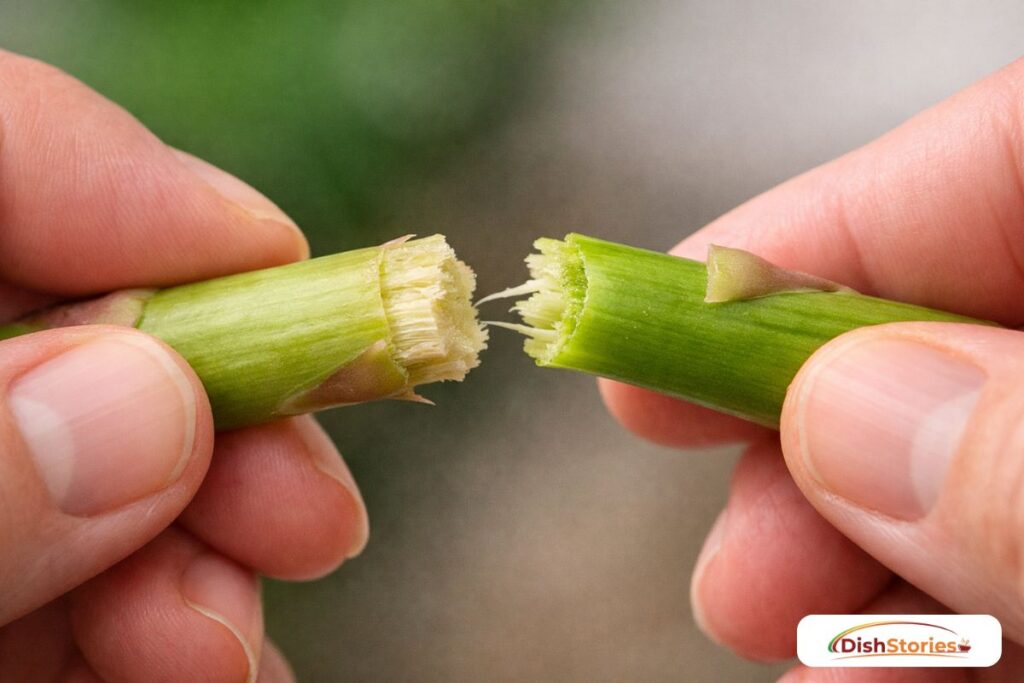
Every asparagus spear has two parts: the tender tip (the “flower”) and the fibrous base. The base is designed to transport water, making it woody and difficult to chew.
The Snap Test vs. The Knife
Don’t just chop off the ends. Hold a single stalk at the bottom and the middle and bend it until it snaps. It will naturally break at the exact point where the woody fiber ends and the tender part begins. You can then use that stalk as a guide to trim the rest of the bunch.
Thickness and Heat Transfer
- Pencil-Thin Spears: Roast very quickly. If you use these, add them to the pan halfway through the salmon’s cook time.
- Jumbo Spears: These are actually my preference for a salmon asparagus oven bake because they can withstand 15 minutes of high heat while staying succulent inside.
The Culinary Authority: Mastering the “Meunière” Influence
This garlic lemon salmon recipe is actually a modern, one-pan take on the classic French Sole Meunière. Traditionally, fish is dredged in flour and sautéed in a “brown butter” (beurre noisette) with lemon and parsley.
By roasting the lemon garlic butter salmon recipe at 400°F, we are mimicking that brown butter effect without the mess of stovetop frying. The milk solids in the butter caramelize on the sheet pan, creating a nutty, toasted flavor profile that perfectly complements the earthiness of the roasted asparagus with salmon.
How to Cook Lemon Garlic Butter Salmon with Asparagus in 20 Minutes (Step-by-Step with Pro Tips)
This is where technique meets intention. Anyone can follow steps—but understanding why they work is what gives you consistency.
Step 1: Bring Salmon to Room Temperature
Never put cold salmon into a hot oven. Let it sit for 15–20 minutes. This allows the center to cook at the same rate as the outside, preventing that “rubbery” texture.
Why it matters:
• Prevents uneven cooking
• Helps the center cook at the same rate as the outside
• Allows butter sauce to coat more evenly
Let it sit for 15–20 minutes. It’s a small pause that makes a big difference
Step 2: Dry Everything Thoroughly
Moisture equals steaming; dryness equals roasting. Pat your salmon and asparagus dry with paper towels until they are matte. This ensures a slight crisp on the vegetables and more concentrated flavor.
Moisture = steaming
Dry surface = roasting
• Pat salmon dry
• Pat asparagus dry
This ensures:
• Slight crisp on asparagus
• Better texture overall
• More concentrated flavor
Step 3: Preheat the Sheet Pan (The Pro Secret)
Place your empty sheet pan in the oven while it heats to 400°F ($200^\circ C$). When the food hits the hot surface, it starts caramelizing immediately. This prevents the sogginess that plagues many home-cooked sheet pan dinners.
Place your empty sheet pan in the oven while it heats.
When asparagus hits a hot surface, it starts cooking immediately—no lag time.
Result:
• Crisp-tender vegetables
• Slight caramelization
• No sogginess
This one step quietly upgrades your entire sheet pan salmon and asparagus experience.
Step 4: The Maillard Reaction & The Sauce
To understand why this recipe works, we look at the Maillard Reaction. This is a chemical reaction between amino acids and sugars that gives browned food its flavor. By using butter and high heat, you create a flavor profile that is significantly deeper than just “cooked fish.”
Don’t just mix—think about layering:
• Melt butter first
• Add garlic (it infuses the fat)
• Add lemon juice (balances richness)
• Add herbs last (for freshness)
This creates a sauce that coats, flavors, and enhances—not just sits on top.
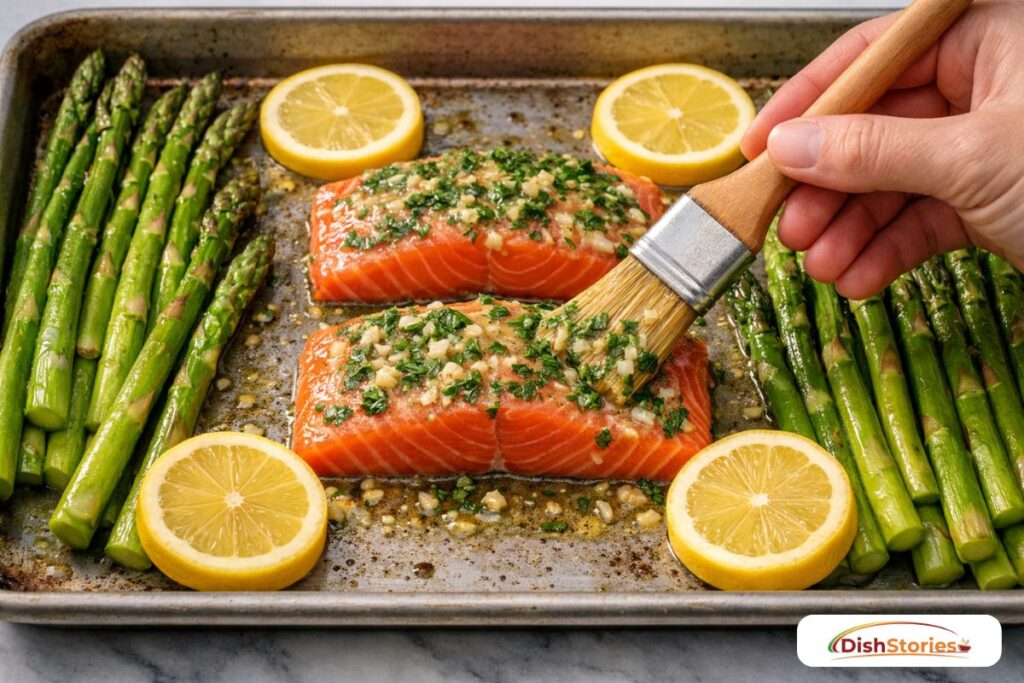
Step 5: Arrange and Bake
Place the thicker salmon pieces in the center of the pan where the heat is most stable. Spread the asparagus out so they aren’t piled on top of each other—overcrowding traps steam. Bake for 12–15 minutes.
• Thicker salmon pieces → center
• Thinner pieces → edges
• Asparagus spread out (not piled)
Overcrowding traps steam. Give everything space.
Step 6: Bake and Trust the Signs
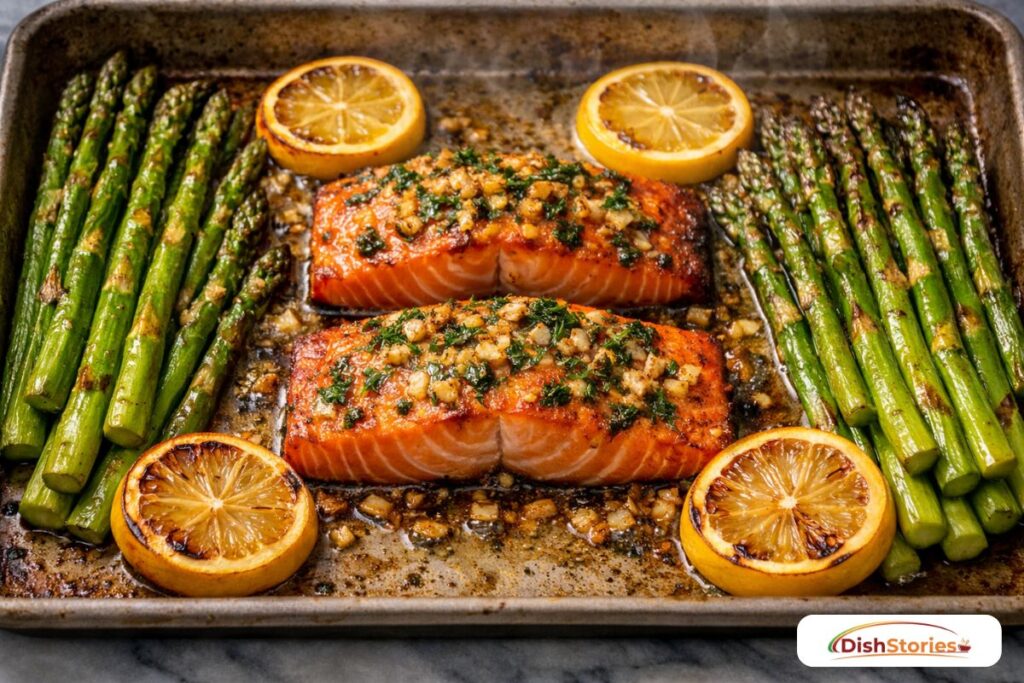
Cook at 400°F (200°C) for 12–15 minutes.
Look for:
• Salmon flakes easily
• Center is opaque but slightly glossy
• Asparagus is tender but still vibrant
Pull it slightly early if unsure—it keeps cooking after removal.
Sheet Pan Lemon Garlic Butter Salmon & Asparagus

Lemon Garlic Butter Salmon & Asparagus
Equipment
- 1 Extra-Large Rimmed Sheet Pan: A heavy-duty 13×18 inch (half-sheet) pan is vital to ensure the salmon and asparagus have enough space to roast rather than steam.
- 1 Professional Chef’s Knife: Essential for the precision slicing of lemon wheels and trimming the asparagus ends.
- 1 Digital Instant-Read Thermometer: The only way to guarantee your lemon garlic butter salmon reaches the perfect internal temperature of 145°F (63°C) without overcooking.
- 1 Stainless Steel Fish Spatula: Its thin, flexible edge allows you to lift the delicate salmon fillets off the pan without breaking the skin.
Ingredients
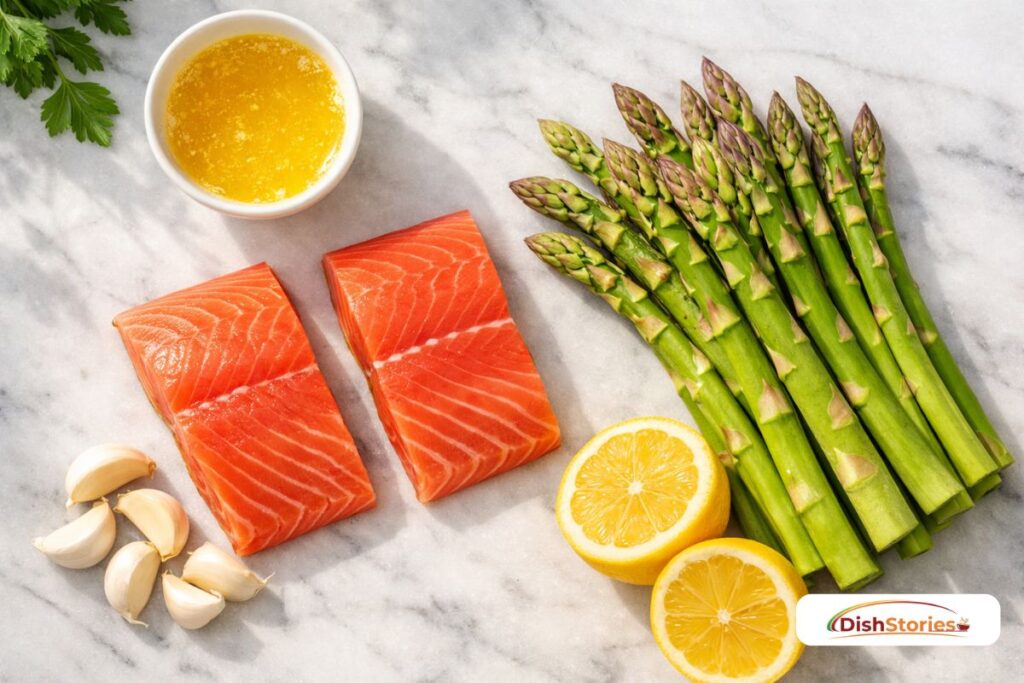
- 2 large salmon fillets about 6 oz each
- 1 bunch asparagus trimmed
- 3 tbsp unsalted butter melted
- 3 cloves garlic minced
- 1 lemon half juiced, half sliced
- 1 tbsp fresh parsley chopped
- Salt and freshly cracked black pepper
Instructions
- Preheat: Set oven to 400°F ($200^circ C$) with the sheet pan inside.
- Prep: Pat salmon and asparagus completely dry.
- Sauce: Whisk together melted butter, garlic, lemon juice, and parsley.
- Assemble: Carefully remove the hot pan. Place asparagus and salmon on it. Drizzle sauce evenly and top salmon with lemon slices.
- Bake: Roast for 12–15 minutes until salmon reaches $145^circ F$ ($63^circ C$) and flakes easily.
- Serve: Serve immediately with any pan juices drizzled on top.
Video
Notes
Nutrition Facts (Per Serving)
- Calories: 485 kcal
- Protein: 38g
- Net Carbs: 4g
- Healthy Fats: 32g (including high concentrations of Omega-3)
- Fiber: 3g
- Vitamin K: 110% DV (from asparagus)
Pro-Tip for DishStories Readers:
If you are looking to upgrade your kitchen arsenal for better results, be sure to read my expert guide on the Best Rated Knives by Chefs: The Ultimate Guide to What Top Chefs Actually Use. Using the right blade makes prep work safer and much faster!
Advanced Expertise: Global Flavor Variations
Once you’ve mastered the base lemon garlic butter salmon, you can use these variations to keep your weekly meal plan exciting:
- The Tuscan Variation: Add 1/4 cup of halved cherry tomatoes and 1 tablespoon of capers to the pan. The tomatoes will blister and release their juices, creating a rustic sauce that pairs perfectly with the asparagus and salmon recipe.
- The Asian-Fusion Variation: Swap the butter for toasted sesame oil and the lemon for lime juice. Add a teaspoon of grated ginger to the garlic mixture. This transforms your asparagus recipe with salmon into a zesty, umami-rich experience.
- The Spicy Herb Variation: Add 1/2 teaspoon of red pepper flakes and swap parsley for fresh dill. Dill is the classic “soulmate” herb for salmon and adds a refreshing, anise-like finish.
The Connoisseur’s Pairing Guide Lemon Garlic Butter Salmon: Sophisticated Halal Refreshments
To truly elevate this salmon and asparagus in oven dinner, the right beverage is essential. The key is to balance the high fat content of the salmon and the richness of the butter sauce.
The Citrus Pomelo Spritz (The Acid Balancer)
If you find your roasted asparagus with salmon to be particularly savory, you need a beverage with higher acidity to maintain balance.
- The Logic: A sophisticated spritz using fresh grapefruit or pomelo juice mixed with club soda provides a bitter-sweet complexity.
- The Prep: Mix one part fresh-squeezed white grapefruit juice with three parts sparkling water. Garnish with a sprig of fresh rosemary.
- The Result: The rosemary mimics the earthy, herbaceous qualities of the asparagus, while the citrus zest highlights the lemon in the garlic butter sauce.
Premium White Tea (The Warm Pairing)
For those who prefer a warm beverage with their salmon asparagus oven meal, a high-quality, loose-leaf Silver Needle White Tea is the sommelier’s secret.
- The Logic: White tea is the least processed of all teas and possesses a delicate, floral, and slightly hay-like profile.
- The Prep: Brew at a lower temperature (around 175°F or 80°C) to prevent tannins from becoming bitter.
- The Result: The tea’s natural sweetness and silky mouthfeel complement the flakiness of the salmon perfectly, while its subtle astringency helps break down the richness of the butter sauce on the tongue.
Sparkling Apple & Elderflower Pressé
When you want something with more body and a hint of sweetness to contrast the saltiness of the dish, an Apple and Elderflower Pressé is unmatched.
- The Logic: The crisp malic acid in green apples mimics the sharp brightness of lemon, while elderflower adds a floral “high note” that elevates the fresh parsley used in the recipe.
- The Prep: Combine equal parts premium cloudy apple juice and elderflower sparkling water. Serve in a chilled flute to maintain the “fine dining” atmosphere of your lemon garlic butter salmon recipe.
Seafood Safety: A Guide to Handling and Storage
High authority means prioritizing your health. When cooking salmon and asparagus, follow these critical food safety steps:
- The Thaw: If using frozen fillets, never thaw them on the counter. Always thaw in the refrigerator for 12–24 hours. This prevents the “Danger Zone” ($40^\circ F$ to $140^\circ F$) where bacteria multiply rapidly.
- The Scent Test: Fresh salmon should smell like the ocean—briny and fresh. If it smells “fishy” or like ammonia, the fats have begun to oxidize, and it is past its prime.
- Internal Temperature: While many chefs prefer salmon “Medium” ($130^\circ F$), the FDA recommends an internal temperature of $145^\circ F$ ($63^\circ C$) for absolute safety.
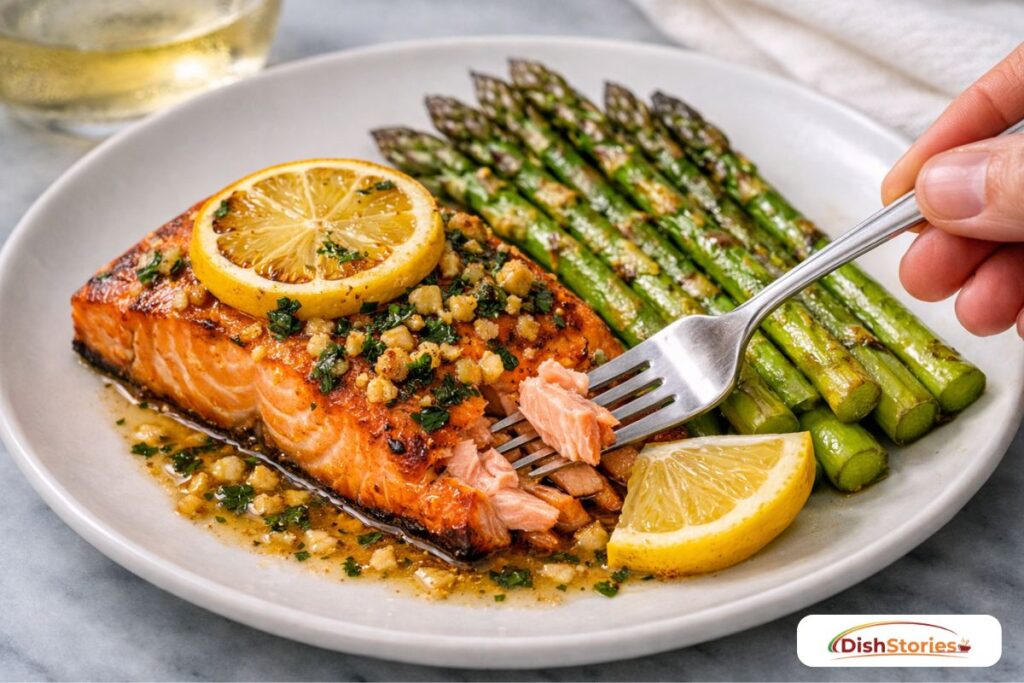
To ensure your fish is cooked perfectly while maintaining food safety, always refer to the USDA Safe Minimum Internal Temperature Chart to verify that your salmon has reached 145°F (63°C).
FAQ: Common Problems & Expert Solutions
Can I use frozen salmon?
Yes, but thaw it overnight in the fridge and dry it thoroughly. If it’s even slightly wet, the asparagus and salmon bake will turn out soggy.
Why is my salmon dry?
You likely overcooked it. Even 2 extra minutes can make salmon go from silky to dry. Use a meat thermometer to pull it at $135^\circ F$; carry-over cooking will do the rest.
Can I substitute butter?
Yes. Extra virgin olive oil works well, though you lose the rich “brown butter” flavor.
How do I avoid soggy asparagus?
Two things: dry it completely and don’t overcrowd the pan. Space is the key to roasting.
What if my fillets are different sizes?
Put the thicker pieces in the center of the pan and the thinner ones on the edges where the heat is slightly less direct.
Can I add potatoes to this?
Yes, but potatoes take much longer to cook. Roast them for 15 minutes before adding the salmon and asparagus to the pan.
Is this keto-friendly?
Absolutely. It is naturally high-fat and low-carb, making it a perfect keto dinner.
Why does my garlic taste bitter?
It likely burned. Ensure the garlic is well-coated in the butter so it “confits” in the fat rather than scorching on the dry pan.
Can I use foil or parchment?
Parchment is best for preventing sticking, while foil makes cleanup faster. Both work perfectly for this salmon asparagus sheet pan recipe.
How do I boost the flavor even further?
Add a pinch of red pepper flakes for heat, a teaspoon of honey for a glaze, or extra lemon zest for a punchy citrus finish.
Helpful Resources
If you appreciate the efficiency of one-pan meals, you must try The Ultimate Sheet Pan Garlicky Lemon Chicken , which uses a similar high-heat roasting technique for maximum flavor.
While lemon and garlic are classic, those looking for a more exotic, sweet-and-savory profile should explore my Delicious Sticky Date & Tahini Salmon Recipe.
Storage, Reheating & Meal Prep Tips
Storage
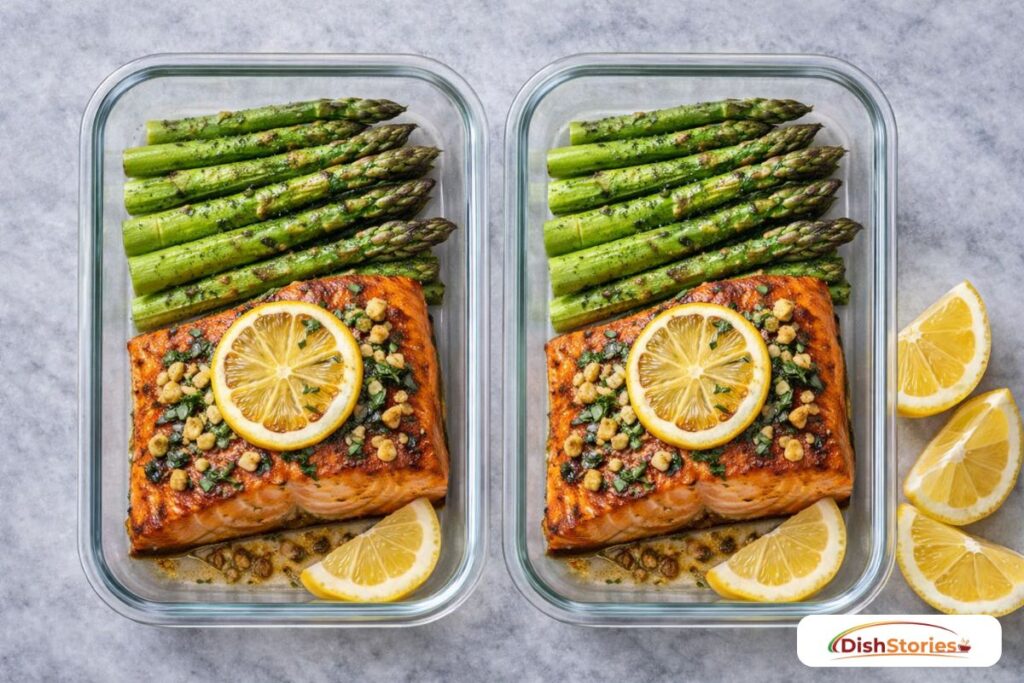
Store leftovers in an airtight glass container. It will stay fresh for up to 48 hours. Avoid plastic containers if possible, as they can sometimes retain the scent of the fish.
Reheating (The “Gentle” Method)
Never use a microwave for salmon if you can avoid it. It will turn your fish into rubber. Instead:
- Preheat oven to 275°F ($135^\circ C$).
- Place salmon and asparagus on a tray with a splash of water or a small pat of butter.
- Cover with foil and heat for 10 minutes. This creates a “steam tent” that keeps the fish moist and tender.
Meal Prep Strategy
If you’re planning ahead, slightly undercook the salmon. When you reheat it later, it will finish cooking perfectly without drying out. A small squeeze of fresh lemon after reheating brings the dish back to life.
Final Thoughts: Why This Recipe Sticks
Lemon garlic butter salmon isn’t just about speed—it’s about reliability. It’s the kind of meal that works when you’re tired, feels healthy without trying too hard, and delivers consistent results every single time.
More importantly, it teaches you something. That great cooking isn’t about complexity—it’s about understanding small, intentional decisions: letting food come to room temperature, managing moisture, and balancing fat with acid. Once you understand those, you’re not just making roasted asparagus with salmon—you’re building your own culinary intuition. And on a long Tuesday night, that might be the most valuable thing of all.